San Juan Islands: The Pig War That Nearly Started a US-British Conflict
Show Notes
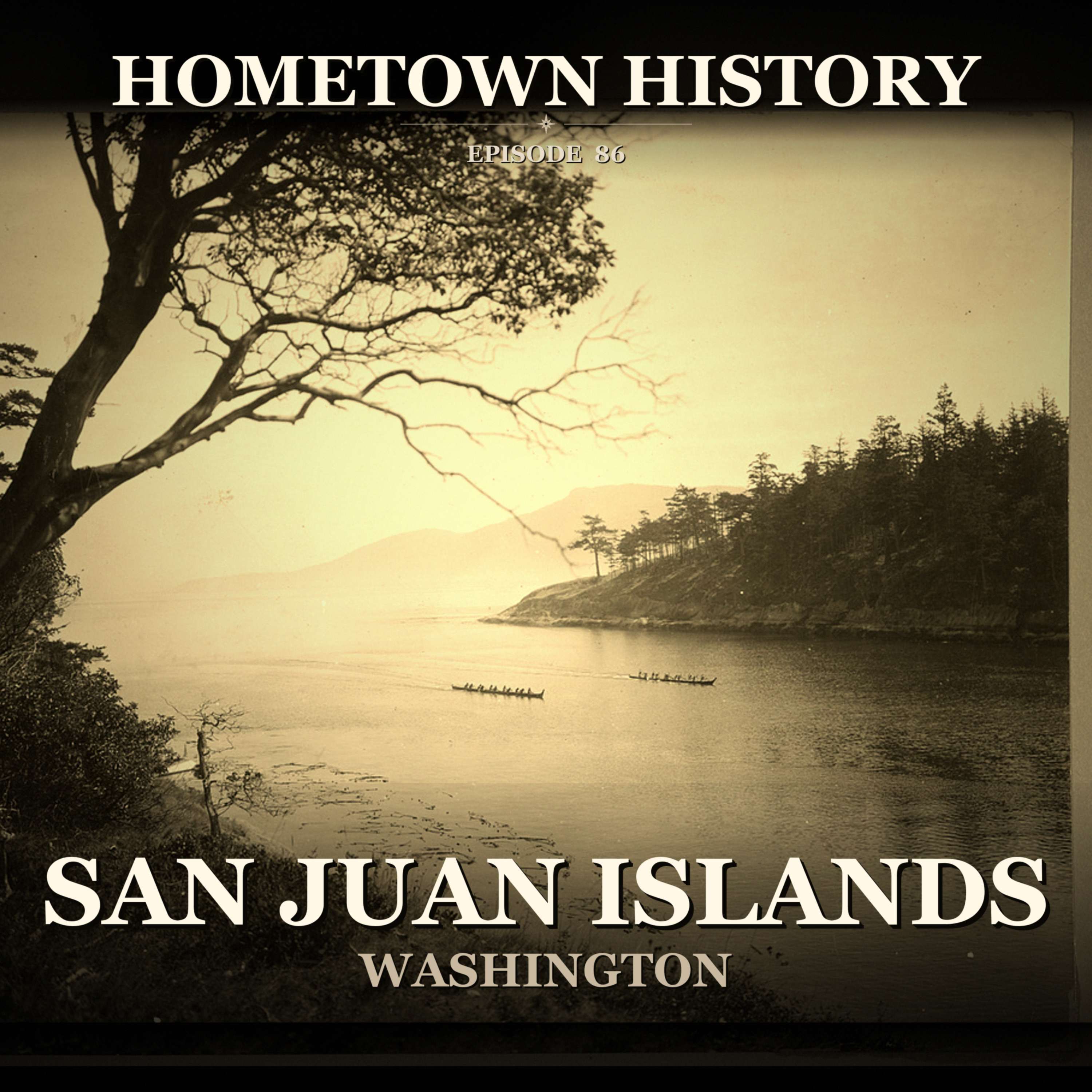
In June 1859, an American farmer's frustration with a rooting pig triggered one of the strangest international confrontations in North American history. When Lyman Cutlar shot a Hudson's Bay Company pig eating his potatoes on San Juan Island, he set in motion a territorial dispute that would see the United States and Great Britain deploy hundreds of troops, multiple warships, and artillery batteries to a remote Pacific Northwest island. This extraordinary standoff, known as the Pig War, arose from ambiguous treaty language that left ownership of the San Juan archipelago dangerously unclear.
The roots of the conflict trace back to the 1846 Oregon Treaty, which established the US-Canadian border along the 49th parallel but used vague language about the maritime boundary through the island chains between Vancouver Island and the mainland. Both nations interpreted the treaty differently: Britain claimed the boundary ran through Rosario Strait (giving them the San Juan Islands), while the United States insisted on Haro Strait (placing the islands under American control). By 1859, tensions between American settlers and the British Hudson's Bay Company had reached a breaking point, with both sides claiming jurisdiction over the strategically valuable islands. Part 1 of this two-part series explores how a dead pig transformed a simmering border dispute into a military confrontation that threatened to ignite war between two great powers.
Timeline of Events
June 15, 1859: American settler Lyman Cutlar shoots a Hudson's Bay Company pig owned by British employee Charles Griffin after repeated intrusions into his potato garden. Griffin demands $100 compensation; Cutlar offers only $10, leading to a bitter dispute.
July 27, 1859: Captain George Pickett lands on San Juan Island with 66 US infantry soldiers, establishing American military presence near the Hudson's Bay Company's Belle Vue Sheep Farm.
Early August 1859: British Governor James Douglas orders three Royal Navy warships under Captain Geoffrey Hornby to San Juan Island. By August 10, American forces grow to 461 troops with 14 cannons, while British deployment reaches approximately 2,140 troops and five warships—creating a powder keg that threatens to explode into full-scale war.
August 3, 1859: Admiral Robert Baynes arrives and famously refuses Governor Douglas's order to attack, stating he would not "involve two great nations in a war over a squabble about a pig."
October-November 1859: General Winfield Scott arrives to negotiate with British authorities, establishing the joint military occupation that would keep peace on San Juan Island for the next twelve years.
(Part 2 will cover the joint occupation period and final resolution through Kaiser Wilhelm I's 1872 arbitration.)
Historical Significance
The Pig War represents a crucial turning point in Anglo-American relations and the peaceful resolution of international disputes. Despite deploying overwhelming military force to a contested territory, both nations ultimately chose diplomacy over warfare, establishing a precedent for arbitration that would influence international law for generations. The conflict also highlights the dangers of ambiguous treaty language and the importance of precise diplomatic wording in preventing escalation.
General Winfield Scott's skilled negotiation prevented what could have become a catastrophic war between the world's two most powerful English-speaking nations at a time when the United States was already teetering on the brink of civil war. The joint military occupation that followed demonstrated remarkable restraint, with American and British forces coexisting peacefully on opposite ends of the island for over a decade—sharing celebrations, competing in athletic events, and maintaining friendly relations despite representing rival territorial claims.
The eventual resolution through German Kaiser Wilhelm I's arbitration in 1872 established the Haro Strait as the boundary, awarding the San Juan Islands to the United States and finalizing the US-Canadian border in the Pacific Northwest. Today, both American Camp and English Camp are preserved as part of San Juan Island National Historical Park, commemorating a conflict that was resolved through patient diplomacy rather than bloodshed—with the only casualty being one unfortunate pig.
Sources & Further Reading
- San Juan Island National Historical Park - Official NPS site with historical documents and visitor information
- Vouri, Mike. The Pig War: Standoff at Griffin Bay - Definitive account of the confrontation
- HistoryLink.org: Pig War Historical Essays - Comprehensive Washington state history resources
- Treaty of Washington (1871) - Original arbitration documents
Support this podcast at — https://redcircle.com/hometownhistory/exclusive-content
Advertising Inquiries: https://redcircle.com/brands
Privacy & Opt-Out: https://redcircle.com/privacy
Credits
Shane Waters — Founder & Host
Produced by Myths & Malice