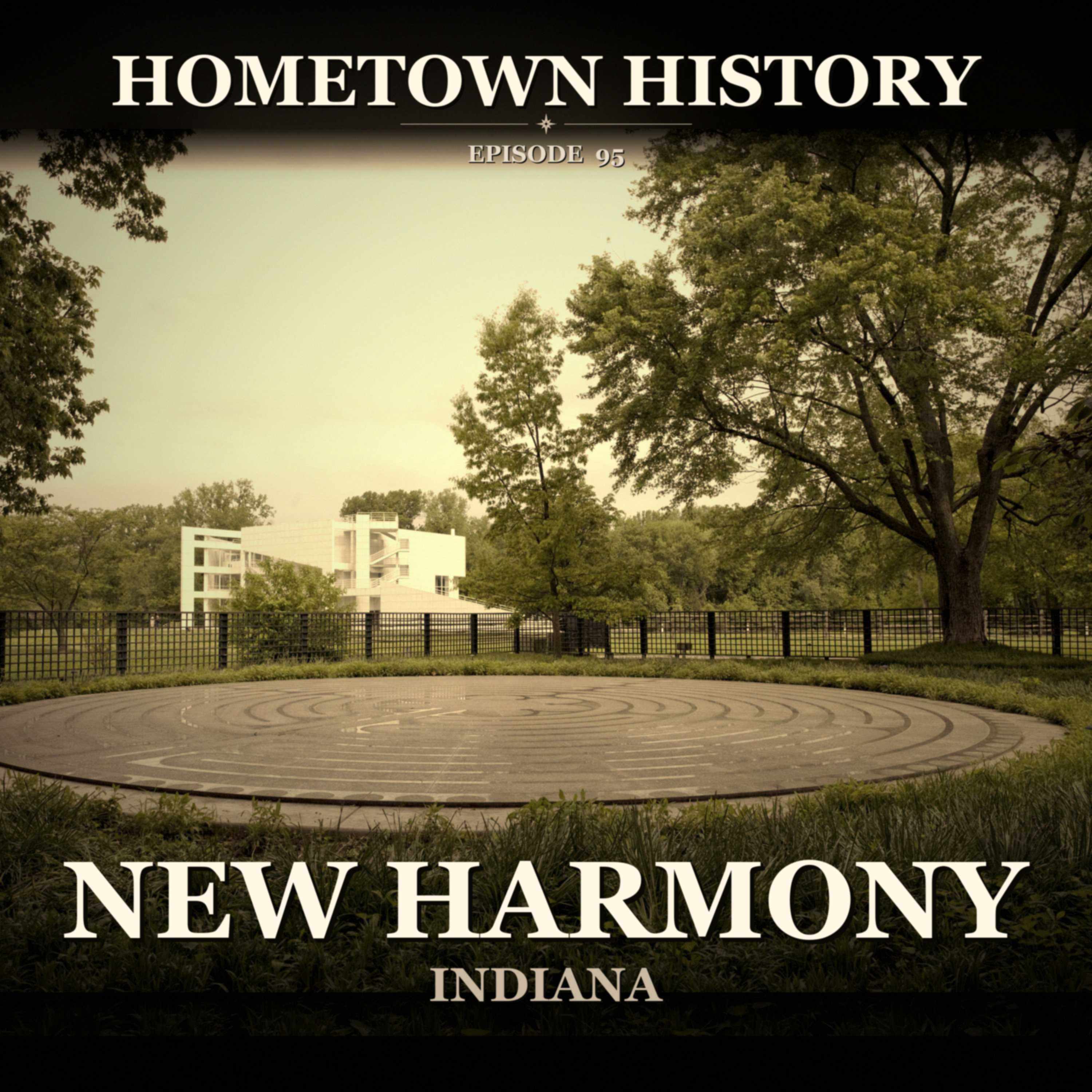
New Harmony, Indiana: The German Commune That Built and Sold a Town
Show Notes
In 1814, a group of German religious separatists did something almost unheard of in American history: they built an entire town from scratch in the Indiana wilderness, made it flourish for a decade, then sold the whole thing—buildings, businesses, and all—to a wealthy industrialist for $150,000. This is the story of New Harmony, where two of America's most ambitious communal experiments played out on the same plot of land along the Wabash River.
The town's first chapter began with Johann Georg Rapp, a German mystic known as Father Rapp, who led his followers—called the Harmonists—from Württemberg to the Indiana frontier. These weren't just idealistic dreamers. They were skilled craftsmen, farmers, and merchants who had already succeeded once before in Pennsylvania. In Indiana, they built a thriving town called Harmony featuring brick mansions, a massive church, mills, distilleries, and vineyards. They produced whiskey that sold throughout the region, wine that earned recognition back east, and by 1825 had created one of the most prosperous settlements in the Northwest Territory.
But the Harmonists had one defining characteristic that made them different from most frontier communities: they practiced celibacy. Every member, including those already married when they joined, lived under this strict religious requirement. Combined with their commitment to communal property, German language, and Father Rapp's authoritarian leadership, the Harmonists created a highly disciplined society that could accomplish remarkable things—but couldn't sustain itself through natural population growth.
In 1824, after just ten years in Indiana, the Harmonists decided to sell everything and return to Pennsylvania. Their buyer was Robert Owen, a Welsh textile magnate who had made his fortune running progressive cotton mills in Scotland. Owen had radically different ideas about creating the perfect community. Where the Harmonists relied on strict religious discipline, Owen believed in secular education, scientific inquiry, and what he called "rational living." He renamed the town New Harmony and recruited intellectuals, educators, and freethinkers from across America and Europe to join his grand social experiment.
Owen's community would last barely two years before collapsing into factionalism and debt. The contrast between these two communes—one religious and authoritarian, one secular and democratic—reveals something fundamental about what makes intentional communities succeed or fail. This is Part 1 of our New Harmony series, where we explore the Harmonist era and the factors that led them to build, prosper, and ultimately abandon their Indiana settlement.
Timeline of Key Events
1804-1814: Harmonists establish first settlement in Harmony, Pennsylvania, after emigrating from Germany. Community practices celibacy, communal property, and German language exclusivity under Father Rapp's leadership.
1814: First Harmonists depart Pennsylvania for Indiana Territory in June. Town plan for new "Harmony" settlement laid out August 8, 1814, along the Wabash River.
1814-1824: Harmonists build thriving Indiana town with brick buildings, church, distilleries, mills, and vineyards. Population reaches approximately 700-800 members. Community produces whiskey, wine, textiles, and other goods that generate substantial wealth.
1824-1825: Harmonists negotiate sale of entire Indiana settlement to Robert Owen for $150,000, including 20,000 acres and all buildings. Transaction completed January 1825. Community returns to Pennsylvania to establish new settlement called Economy (modern-day Ambridge).
1825-1827: Owen renames town "New Harmony" and launches secular communal experiment attracting intellectuals and scientists. Owen's son David Dale Owen becomes prominent geologist. Community struggles with lack of organization and conflicting visions.
Historical Significance
New Harmony represents a unique case study in American communal living where two radically different philosophies occupied the same physical space in rapid succession. The Harmonists demonstrated that strict religious discipline, skilled labor, and centralized leadership could create economic prosperity even on the frontier. Their success challenged assumptions about what was possible in the wilderness and showed that communal property arrangements could generate wealth when properly organized.
The transition to Owen's secular experiment revealed the opposite lesson: shared ideals and good intentions couldn't compensate for poor planning and lack of cohesive leadership. While Owen's New Harmony failed as a commune, it succeeded in establishing Indiana's scientific and educational legacy through institutions and families that remained after the community dissolved.
The Harmonists' practice of building entire towns and selling them as complete packages was virtually unprecedented in American history. Their later settlement at Economy, Pennsylvania, became even more prosperous, eventually investing in oil production, railroads, and multiple Pennsylvania communities. The Society didn't dissolve until 1905, having lasted over a century—a remarkable achievement for any intentional community.
New Harmony itself survives today as one of Indiana's best-preserved historic towns, its architecture and town plan still reflecting the German builders who created it. The story of these two communes offers insights into leadership, community organization, religious versus secular foundations, and the challenges of sustaining alternative social experiments in America.
Sources & Further Reading
- Indiana State Museum: New Harmony State Historic Site - https://www.indianamuseum.org/historic-sites/new-harmony/
- University of Southern Indiana: Historic New Harmony - https://www.usi.edu/hnh/about/history
- Pennsylvania Historical & Museum Commission: Old Economy Village - https://www.oldeconomyvillage.org
- National Archives & Records Administration: Harmony Society Collections
- Encyclopedia Britannica: George Rapp and Robert Owen biographical entries
- "New Harmony: Indiana's Utopian Community" - EBSCO Research Starters
Support this podcast at — https://redcircle.com/hometownhistory/exclusive-content
Advertising Inquiries: https://redcircle.com/brands
Privacy & Opt-Out: https://redcircle.com/privacy
Credits
Shane Waters — Founder & Host
Produced by Myths & Malice