Historical true crime. Seasonal investigations.Hosted by Shane Waters and Wendy Cee35 min episode
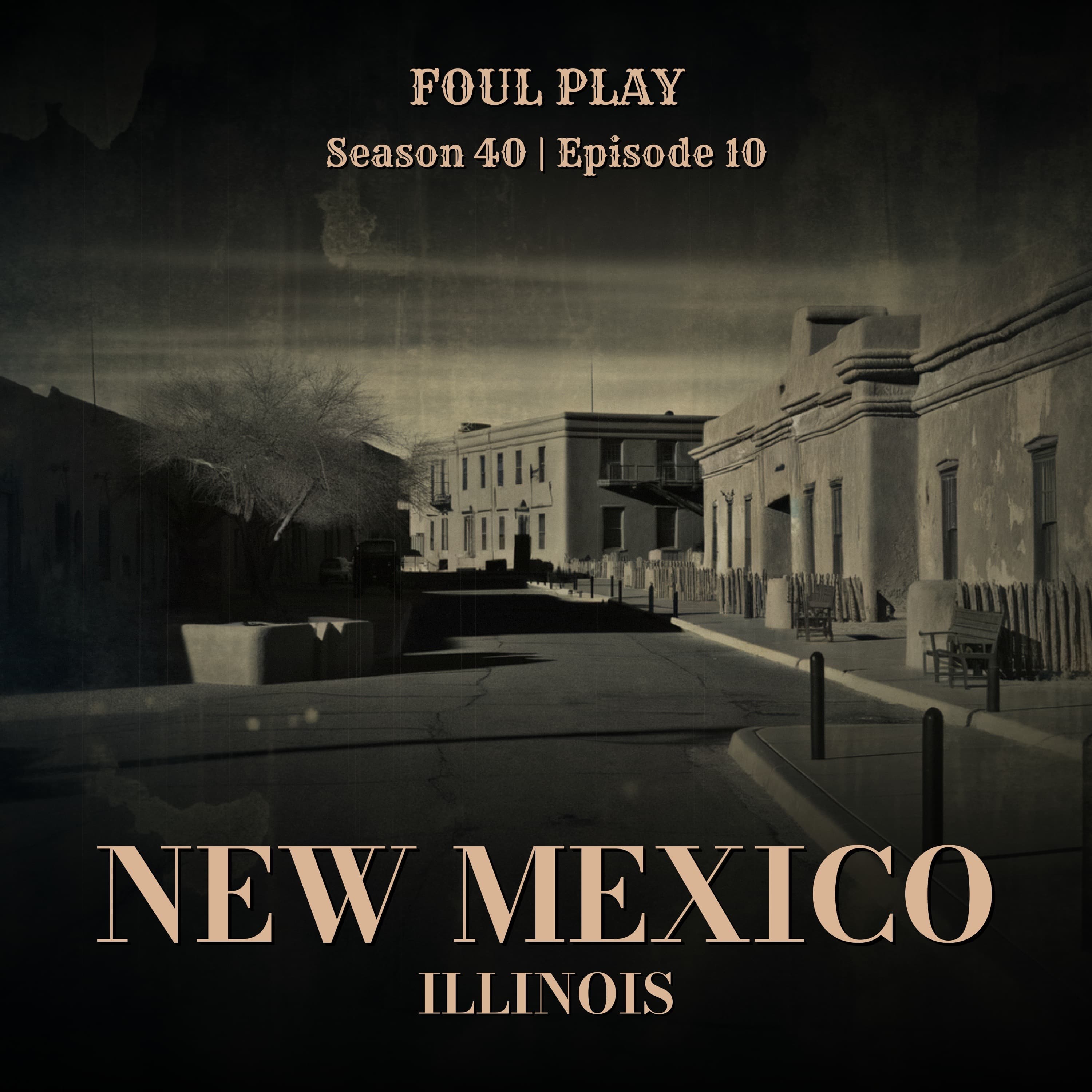
New Mexico & Illinois: Two Political Murders, No Justice
Show Notes
Season 40: America's 250th Anniversary. Fifty states. Fifty crimes. Two hundred and fifty years of American
history, told through the true crime cases that other shows leave behind.
New Mexico, 1892. A former sheriff walks into the dark with a man he trusts and never comes home. Illinois, 1871.
A former Secretary of State steps off his porch for a midnight train and is shot dead in the street. Both men
served their communities. Both were killed for it. Both were largely forgotten — until now. This is historical true
crime, and tonight both cases are about what happens when political power turns lethal.
Case A: Francisco Chavez and the Santa Fe Ring
Francisco Chavez was born around 1851 in New Mexico Territory, the son of a family that had shaped this region
for generations before the American flag flew over Santa Fe's plaza. He was Hispanic, a nuevomexicano, and he
became sheriff of Santa Fe County at a time when the territory's government had been captured by the Santa Fe
Ring — an informal network of Anglo-American lawyers, politicians, and land speculators who exploited Spanish
and Mexican land grants to strip Hispanic families of land they had occupied for generations.
At the center of the Ring stood Thomas Catron, a Confederate veteran and Missouri lawyer who arrived in New
Mexico in 1866. By the 1890s, Catron had acquired interests in thirty-four land grants totaling approximately
three million acres — making him, by most accounts, the largest private landowner in the United States. He had
served as district attorney, territorial attorney general, and U.S. attorney. He owned the territory as surely as
anyone could.
Chavez stood against him. Historian Tobias Duran, writing in the New Mexico Historical Review, called Chavez a
formidable foe of the Santa Fe Ring. He was the rare Hispanic Democrat using the blunt authority of the sheriff's
office to push back against the most powerful men in the territory.
On the night of May 29, 1892, Chavez was lured from a Santa Fe bar by a man named Atilano Gold — someone
he trusted. Gold walked him toward the Guadalupe bridge, near the Santuario de Nuestra Señora de Guadalupe,
the oldest shrine to Our Lady of Guadalupe in the United States. Armed men waited behind a telegraph pole.
Chavez was shot multiple times. His last words, spoken in Spanish, were that brutes had assassinated him.
Four men were indicted: Francisco Gonzales y Borrego, his brother Antonio, Laureano Alarid, and Patricio
Valencia. Their defense attorney was Thomas Catron — the man widely suspected of ordering the murder,
now defending the accused killers. The prosecution's key witness, Juan Gallegos, testified that a $700 payment
had been offered through intermediaries for Chavez's death. Judge Seeds ruled that he did not believe Catron
personally made the offer, but accepted the conspiracy existed. That distinction shielded Catron from criminal
liability.
All four defendants were convicted and sentenced to death. Appeals dragged on for nearly five years. On April
2, 1897, they were hanged simultaneously at the Santa Fe jail grounds. Forty-five National Guard soldiers were
present. At 9:09 AM, the trap bolt was drawn. Three necks broke on impact. Patricio Valencia strangled for three
to four minutes before he died.
Thomas Catron was never charged. When New Mexico achieved statehood in 1912, the territory he had helped
plunder elected him as one of its first two United States Senators. He died in 1921. A former senator. Never
charged. Never tried.
Case B: Sharon Tyndale and the Seal That Outlasted Him
Sharon Tyndale was born in Philadelphia on January 19, 1816. He arrived in Belleville, Illinois in 1833 — the same
year Chicago was incorporated as a town — and spent the next three decades building railroads and building a
career. Abraham Lincoln personally appointed him Postmaster of Belleville in 1861. When Lincoln was assassinated
in 1865, Tyndale was among the committee members who received the president's coffin in Springfield. He was
one of the original fifteen members of the National Lincoln Monument Association, the group that built Lincoln's
tomb at Oak Ridge Cemetery.
In 1865, Tyndale was elected Illinois Secretary of State. His younger brother Hector had bled for the Union at
Antietam, was promoted to brigadier general, and was later breveted major general for gallantry. The family's
loyalty to the Union was bone-deep.
In 1867, the Illinois legislature authorized a new state seal. Tyndale proposed reversing the state motto from "State
Sovereignty, National Union" to "National Union, State Sovereignty." The Civil War had settled that question with
blood. The Senate rejected his proposal. So the legislature gave him the wording and handed him the design.
Tyndale kept the words in their mandated order. But he designed the banner in the eagle's beak to twist, placing
the word "Sovereignty" upside down. The seal entered use in 1868. More than a hundred and fifty years later, the
word "Sovereignty" still hangs inverted on the Great Seal of the State of Illinois.
On April 29, 1871, two years after leaving office, Tyndale walked out of his home on Adams Street in Springfield
just after one in the morning, heading to the Chicago & Alton railroad station for a 1:50 AM train. On the dark
street, steps from his own front door, someone clubbed him to the ground and shot him behind the right ear with
a single-shot Derringer — the same type of weapon used to kill Abraham Lincoln six years earlier. His $50 wallet
was taken. His gold watch was not. His killer was never identified.
A five-thousand-dollar reward went unclaimed. Four theories competed — robbery, romantic entanglement,
political enemies, railroad business dispute — and the competition destroyed the investigation. The 1929 Illinois
State Journal concluded the welter of possible motives had hindered the case. No arrest was ever made.
The seal lives on. Every official document issued by the State of Illinois, every state flag that flies over Springfield,
still carries the handiwork of a man who was murdered two years after completing it.
Our Sponsors:
* Check out Kensington Publishing: https://www.kensingtonbooks.com
Advertising Inquiries: https://redcircle.com/brands
Privacy & Opt-Out: https://redcircle.com/privacy
Credits
Shane Waters, Founder & Host
Wendy Cee, Co-Host
Produced by Myths & Malice
Listen to Foul Play: A Historical True Crime Podcast
Get More from Foul Play: A Historical True Crime Podcast
Unlock exclusive content and support the show.
- Ad-free listening
- Early access to episodes
- Bonus episodes
- Support independent podcasting
the M&M Dispatch
Get new Foul Play: A Historical True Crime Podcast episodes and case updates from across the network.
Enjoying Foul Play: A Historical True Crime Podcast?
Leave a rating on Apple Podcasts. It takes a few seconds and helps new listeners find the show.