Historical true crime. Seasonal investigations.Hosted by Shane Waters and Wendy Cee35 min episode
Kansas and Virginia: Badges, Betrayal, and Frontier Justice
Transcript
336 segmentsShow Notes
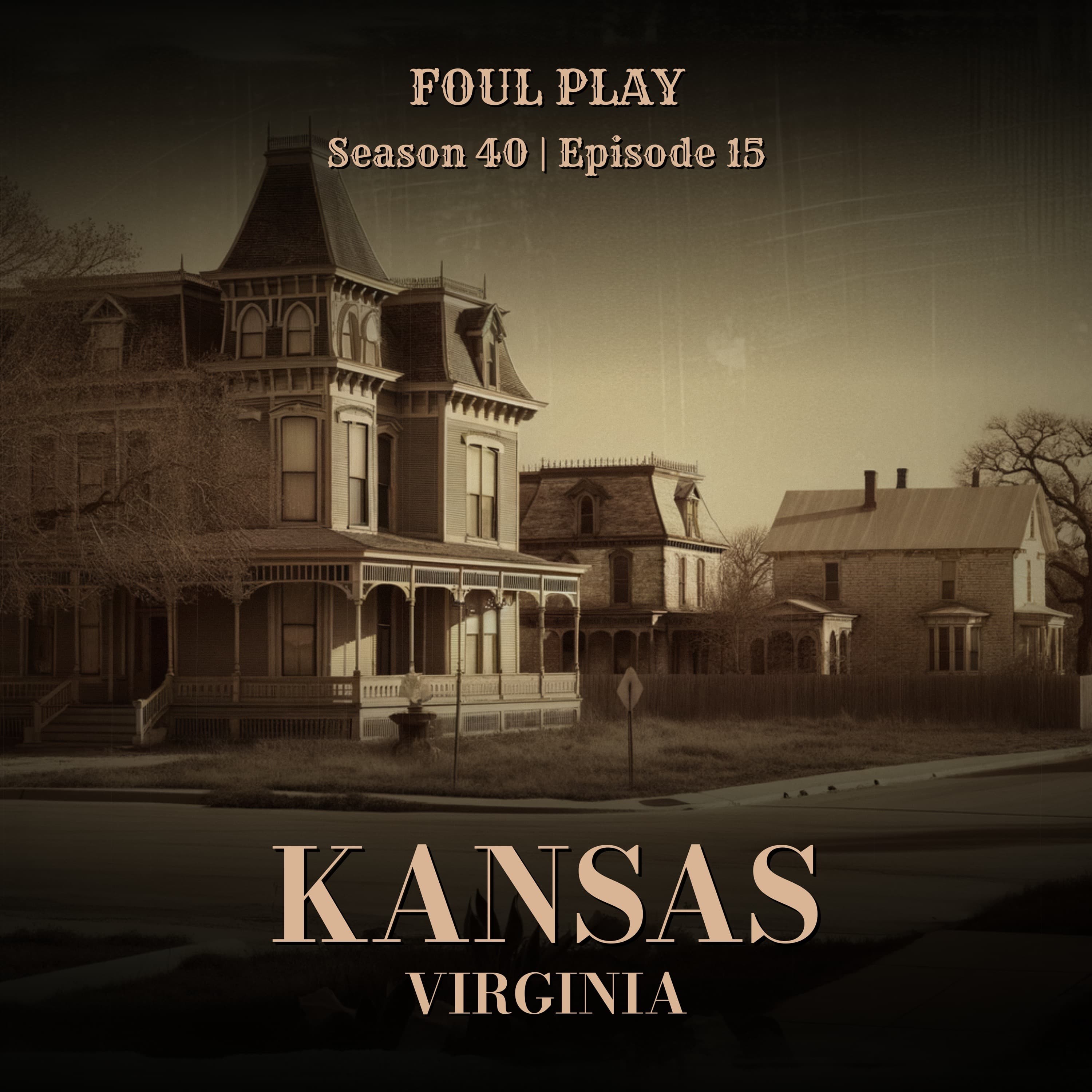
Season 40: America's 250th Anniversary — fifty states, fifty crimes, two hundred and fifty years. This double--
feature episode covers Kansas and Virginia.
A city marshal with a gold-engraved Winchester and a secret past as a wanted killer. A mountain doctor who
preached Sunday sermons and planned a massacre on a mountain road. Two men who wore badges. Two
communities that trusted them. Two moments when the authority collapsed and the man underneath it was
exposed. This is the story of Henry Newton Brown and Marshall Benton "Doc" Taylor — and the people they
killed.
The Victims
**E.W. Wylie Payne** was the president of the Medicine Valley Bank in Medicine Lodge, Kansas. He was a
Missouri-born businessman, married to Susan, and the father of nine children. He was shot during a robbery on
April 30, 1884, and died the following day — May 1, 1884. **George Geppert**, the bank's chief cashier, was
shot twice during the same robbery. Dying, he sealed the bank vault with his own hands. The robbers escaped
with nothing because of what Geppert did in his final moments.
**Louranza Mullins** was thirty-five years old on May 14, 1892, traveling through Pound Gap on the Virginia-Ken-
tucky border with her husband **Ira Mullins**, **Wilson Mullins**, **John Chappel**, and **Greenberry Harris**.
All five were killed in a planned ambush at a place now called Killing Rock. Two survived: fourteen-year-old **John
Harrison Mullins**, whose left arm was shattered, and **Amoda Jane Mullins**, Ira's sister, who was carrying an
infant and identified the killers by their voices.
The Crimes
**Case A — The Medicine Lodge Bank Robbery (Kansas, 1884):** Henry Newton Brown was city marshal of
Caldwell, Kansas — a man so trusted that citizens presented him a gold-engraved Winchester rifle in January
1883. What no one in Caldwell knew was that Brown was wanted for murder in New Mexico Territory. He had
ridden with Billy the Kid's Regulators and participated in the ambush that killed Lincoln County Sheriff William
Brady in April 1878. On April 30, 1884, five weeks after marrying Alice Maude Levagood, Brown led his deputy Ben
Wheeler (real name: William Sherod Robinson, also a fugitive) and two accomplices to rob the Medicine Valley
Bank. The robbery failed. Cowboys sheltering from a thunderstorm in a nearby livery stable gave chase. The gang
was trapped in a flooded box canyon within three miles. Brown was shot and killed by a mob that night. Wheeler,
Smith, and Wesley were hanged from an elm tree.
**Case B — The Killing Rock Massacre at Pound Gap (Virginia, 1892):** Marshall Benton "Doc" Taylor was a
physician, Baptist preacher, and former federal revenue officer in the Appalachian coalfields of Wise County,
Virginia. In 1889, Taylor led a posse that intercepted a Mullins whiskey wagon on the main street of Wise
Courthouse — approximately 250 shots were exchanged. The wagon driver was killed, Ira Mullins was shot
through both hips and crippled for life, and several others were wounded. Taylor lost his federal appointment.
Three years later, on May 14, 1892, Taylor and brothers Henan and Calvin Fleming ambushed the Mullins party at
Pound Gap, killing five people from behind a breastwork of sandstone and rhododendron.
The Investigation
Taylor fled and was dubbed the Red Fox of the Mountains by the press. Railroad detectives captured him on
August 18, 1892, in an empty freight car at Bluefield, West Virginia. His trial was moved 275 miles to Lynchburg for
security. A ballistics question emerged — rim-fire shells at the scene did not match Taylor's modified center-fire
Winchester — but the jury deliberated two hours and convicted him on five counts of first-degree murder, largely
on the eyewitness identification of Jane Mullins.
Brown's case never reached trial. The mob killed him and his accomplices the night of the failed robbery, after
bank president Wylie Payne died of his wounds. A coroner's jury reported the deaths were at the hands of "a
mob, composed of persons unknown."
Historical Context
Both cases reveal the thin line between law and lawlessness on the American frontier. Brown carried active murder
warrants while serving as one of the most effective marshals in Kansas. Taylor combined medicine, ministry,
and federal authority in a single person — and used all three to position himself for premeditated murder. The
gold-engraved Winchester that Caldwell gave to Brown now sits in the Kansas Museum of History in Topeka
(collection item 209981). The Red Fox Trail runs 1.5 miles through the George Washington and Jefferson National
Forests past the sandstone outcropping called Killing Rock. Every May, descendants of both the Taylor and
Mullins families return there together.
Our Sponsors:
* Check out Kensington Publishing: https://www.kensingtonbooks.com
Advertising Inquiries: https://redcircle.com/brands
Privacy & Opt-Out: https://redcircle.com/privacy
Credits
Shane Waters, Founder & Host
Wendy Cee, Co-Host
Produced by Myths & Malice
Listen to Foul Play: A Historical True Crime Podcast
Get More from Foul Play: A Historical True Crime Podcast
Unlock exclusive content and support the show.
- Ad-free listening
- Early access to episodes
- Bonus episodes
- Support independent podcasting
the M&M Dispatch
Get new Foul Play: A Historical True Crime Podcast episodes and case updates from across the network.
Enjoying Foul Play: A Historical True Crime Podcast?
Leave a rating on Apple Podcasts. It takes a few seconds and helps new listeners find the show.