Historical true crime. Seasonal investigations.Hosted by Shane Waters and Wendy Cee32 min episode
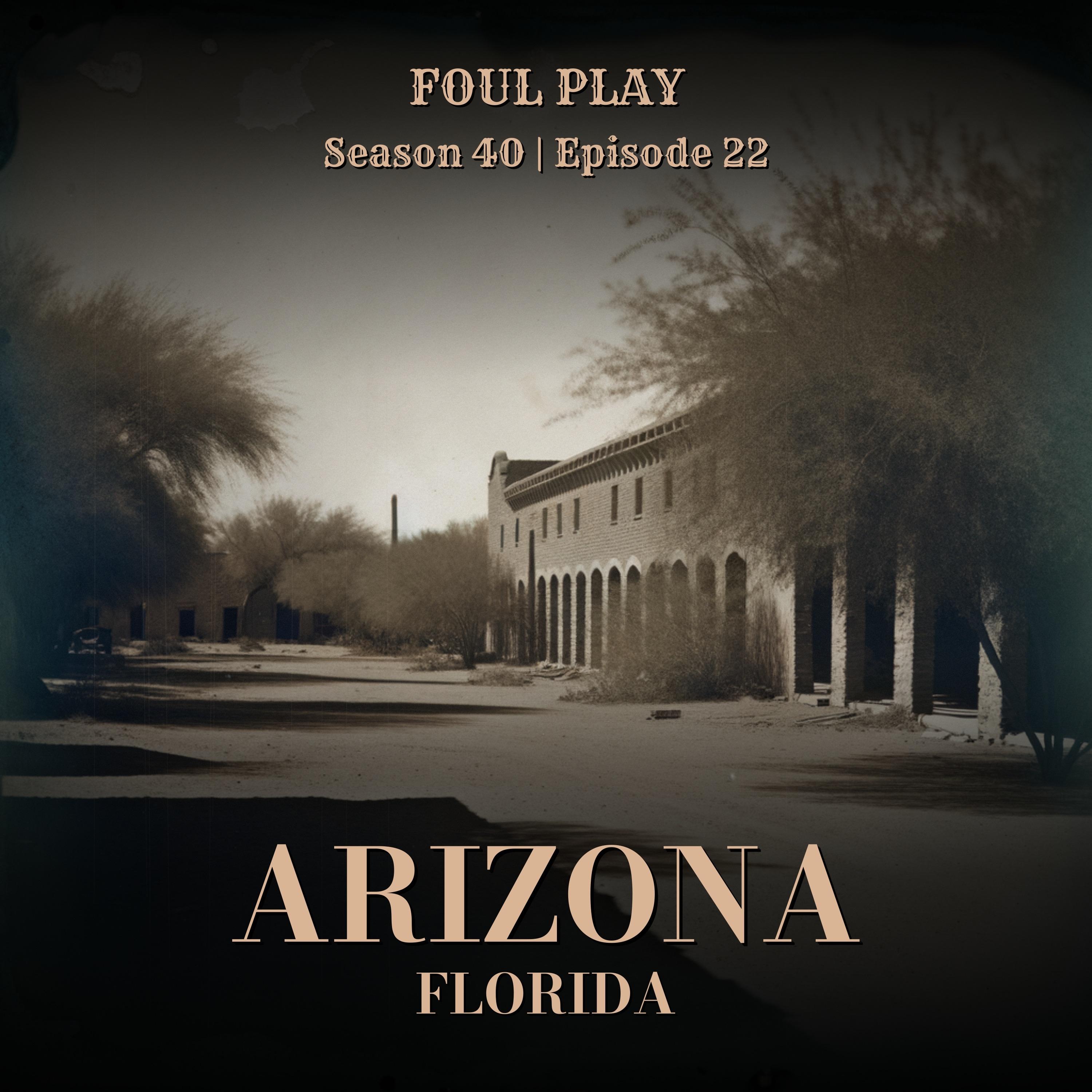
Arizona & Florida: Murder on the Lawless Frontier
Transcript
248 segmentsShow Notes
Season 40: America's 250th — fifty states, fifty crimes, two hundred and fifty years of American history. In
Arizona Territory, 1885, a drifter murders two men on a desert farm and buries them under sunflowers. In Florida,
1884, a secret society of twenty men draws up a kill list and starts crossing off names. Two territories at the
edges of America where violence filled the gap between settlement and law.
The Victims
"General Grant" Jenkins was the caretaker of William Hamilton Williscraft's farm in the Walnut Grove Precinct,
roughly forty miles west of Prescott, Arizona Territory. He had worked the property for years, keeping the fences
standing and the stock watered. In the autumn of 1885, a new farmhand named Dennis Dilda shot Jenkins in the
head and buried him in the garden, replanting sunflowers to hide the freshly turned earth. No one came looking.
Jenkins was invisible — the kind of man whose absence did not make the papers.
Deputy Sheriff John M. Murphy was born in Boston, Massachusetts, in 1844. He had come west as a young man
and worked as a miner before entering law enforcement in Yavapai County. On December 20, 1885, Murphy rode
forty miles to serve a theft warrant on Dilda — not a murder warrant — and was shot in the back. He fired his
needle gun once before he bled to death in the dirt, forty miles from help.
Charles Elliott Abbe arrived in Florida from Chicago in 1877 with his wife Charlotte and their two teenage
daughters, Carrie and Nellie. He had made a fortune selling Singer sewing machines across Kansas. He purchased
three hundred and fifty-nine acres at roughly a dollar an acre and built Sarasota's first general store. On August
16, 1878, Abbe was appointed the settlement's first postmaster, and he later became U.S. Commissioner to the
circuit and district courts. On December 27, 1884 — two days after Christmas — a man named Charles Willard
shot Abbe in the face with a double-barreled shotgun, then rowed his body three miles into the Gulf of Mexico
and dumped it.
Harrison T. "Tip" Riley left his settlement at Myakka City on the morning of June 30, 1884, heading for the post
office in Sarasota. At the intersection of what are now Proctor and Sawyer Roads, three men ambushed him on
horseback: Tom Drymon, Edmund Bacon, and Louis Cato. Eight buckshot hit his head. Twenty-two more hit his
body. Riley gripped a palmetto bush and tried to hold himself upright. Cato walked over and slit his throat.
The Crimes
Dennis Dilda's murders were the work of one man exploiting distance. He killed Jenkins, stole a gold watch and
two pistols from the farmhouse, and blamed the dead man. When Williscraft swore out a theft warrant and Deputy
Murphy came to serve it, Dilda's wife Georgia lied twice — told the deputy her husband was away. Both times,
Dilda was hiding behind a fence, armed and watching. When Murphy turned to leave, Dilda shot him in the back.
Dennis and Georgia dragged the body into the cellar and buried it there.
The Sarasota Assassination Society was something colder: organized murder. Twenty to twenty-two members,
bound by oath, operating under a military-style command structure. Alfred Bidwell and Dr. Leonard Andrews
appointed themselves "judges." Jason Alford held the rank of "captain." Louis Cato and Charles Willard served as
"lieutenants." The cover story was a Democratic club. The reality was a kill list with five names on it: Abbe, Riley,
Greer, Whitaker, and Goings. All prominent landowners. All civic figures. All obstacles.
The Investigations and Aftermath
When Murphy failed to return to Prescott, a manhunt was launched. Both bodies were found: Jenkins under the
sunflowers, Murphy in the cellar. Dilda was convicted in Yavapai County. Georgia Dilda, who lied the deputy to
his death, was never charged. On February 5, 1886 — forty-seven days after Murphy's murder — some eight
hundred spectators packed the jail yard in Prescott. Snow on the ground. Dilda's last words: "Goodbye, boys." In
the crowd, Captain Buckey O'Neill of the Prescott Grays fainted when the trapdoor dropped. Twelve years later,
on July 1, 1898, O'Neill stood at San Juan Hill with Theodore Roosevelt's Rough Riders and was killed by a bullet
to the mouth after telling his men no Spanish bullet had been made that could kill him.
In Florida, Abbe's murder broke the conspiracy open. On February 2, 1885, the New York Times published the
story and gave the group its permanent name. Nine members were indicted. For Riley's murder: Edmund Bacon
received a death sentence; Bidwell and Andrews, accessories before the fact, also received death. For Abbe's
murder: Willard and Anderson received life imprisonment. Two others received life sentences. One was acquitted.
Within a year, Andrews and Bacon secured firearms inside prison and escaped — neither was recaptured.
Bidwell's death sentence was commuted to life. He was sent to a convict lease-labor camp in Live Oak, Florida.
He was eventually released after a few years, and he never returned to Sarasota.
The Sarasota Assassination Society also murdered an unknown number of African-American men whose names
were never recorded and whose deaths were never investigated.
Historical Context
Arizona Territory would not achieve statehood until 1912, twenty-six years after Dilda's hanging. Yavapai County
originally covered sixty-five thousand square miles. Governor Tritle had asked Congress for authorization to form
Arizona Rangers — Congress said no. Law enforcement meant one deputy riding forty miles to serve a warrant.
Florida had been a state since 1845, but its Gulf Coast in 1884 was still described as near-wilderness. The Armed
Occupation Act of 1842 had opened the area to settlement, but the structures of law followed far behind the
first homesteaders.
Our Sponsors:
* Check out Kensington Publishing: https://www.kensingtonbooks.com
Advertising Inquiries: https://redcircle.com/brands
Privacy & Opt-Out: https://redcircle.com/privacy
Credits
Shane Waters, Founder & Host
Wendy Cee, Co-Host
Produced by Myths & Malice
Listen to Foul Play: A Historical True Crime Podcast
Get More from Foul Play: A Historical True Crime Podcast
Unlock exclusive content and support the show.
- Ad-free listening
- Early access to episodes
- Bonus episodes
- Support independent podcasting
the M&M Dispatch
Get new Foul Play: A Historical True Crime Podcast episodes and case updates from across the network.
Enjoying Foul Play: A Historical True Crime Podcast?
Leave a rating on Apple Podcasts. It takes a few seconds and helps new listeners find the show.