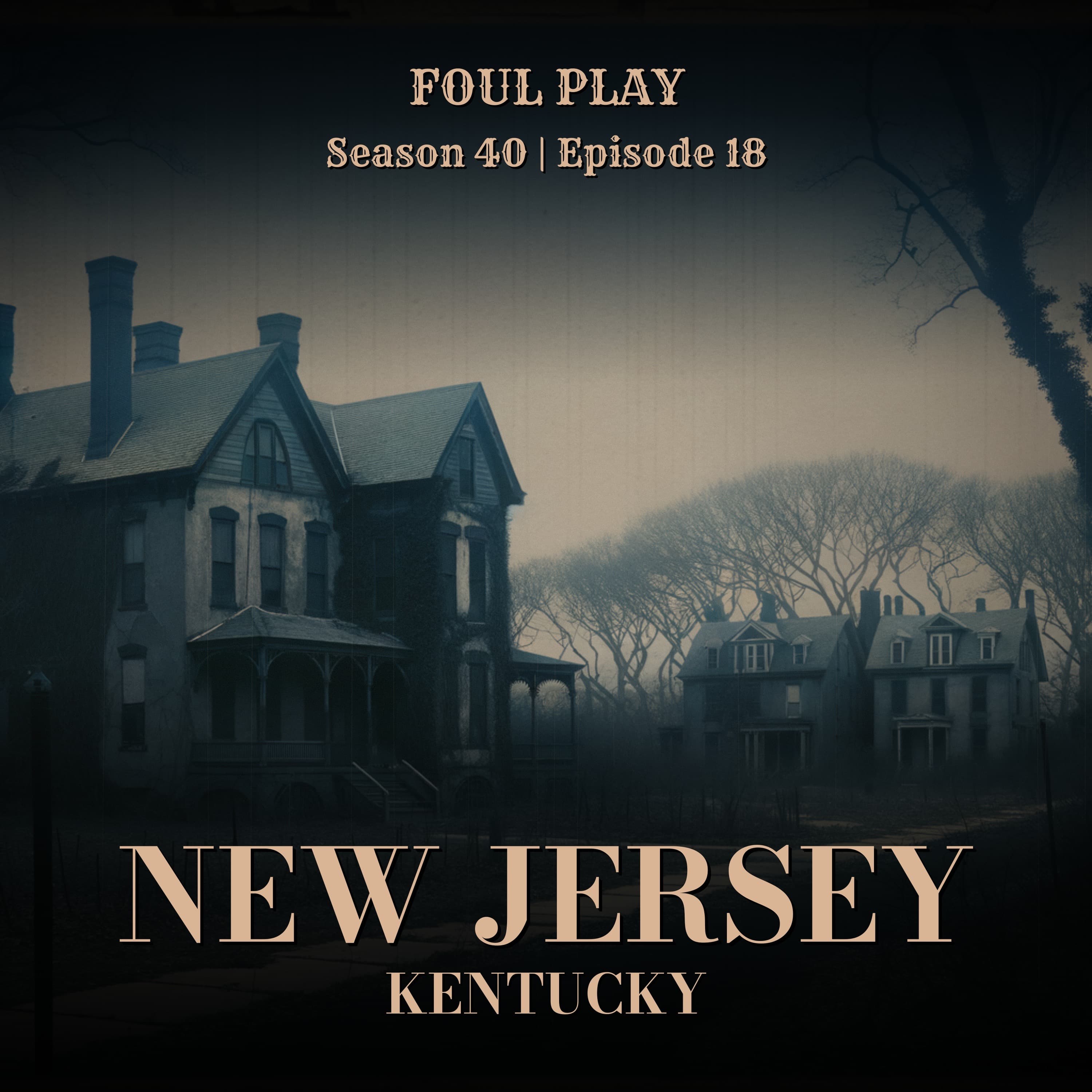
Historical true crime. Seasonal investigations.Hosted by Shane Waters and Wendy Cee32 min episode
New Jersey & Kentucky: Industry and Ambition
Transcript
290 segmentsShow Notes
October 1900, Paterson, New Jersey. A seventeen-year-old silk mill worker named Jennie Bosschieter walks to
a drugstore on a Thursday evening. She never comes home. Four men from the city's wealthiest families drug
her with chloral hydrate, assault her, and leave her body by the Wagaraw Bridge. The murder trial exposes a city
where the families that owned the mills believed they owned the law, too.
Eight hundred miles south, Perry County, Kentucky, 1887. Two merchants in a town called Hazard turn a dispute
over coal mineral rights into a seven-year shooting war. The French-Eversole Feud kills more than twenty
men, burns down the county courthouse, and brings the state militia into Appalachian Kentucky. The outside
companies that started the conflict get exactly what they wanted.
The Victims
Jennie Bosschieter was seventeen years old, Dutch-American, the middle child of an immigrant family living at
155 East Fifth Street in Paterson's Riverside section. She had been working at the Paterson Ribbon Company on
Vreeland Avenue since she was thirteen — twelve-hour shifts on a doubling machine, barely a dollar a day. She
was walking to Kent's Drugstore on Main Street to buy baby powder for her infant niece when she encountered
the men who would kill her.
Joseph Eversole was a merchant, lawyer, and father of seven in Hazard, Kentucky. He traveled Perry County's
hollows warning subsistence farmers that outside agents were buying their coal mineral rights for fifty cents an
acre — a fraction of their value. Nick Combs, Eversole's brother-in-law, was twenty years old when he was killed
alongside Eversole in an ambush on a mountain road in April 1888. Judge Josiah Combs, sixty-two, grandson of
Hazard's founder, was shot at his own doorstep six years later.
The Crimes
**Case A — Paterson, New Jersey (1900):** Walter C. McAlister, Andrew J. Campbell, William A. Death, and
George J. Kerr lured Jennie Bosschieter to Saal's Saloon at River and Bridge Streets. McAlister placed chloral
hydrate in her drinks — two doses, the second lethal. The four men took her in a hired carriage toward the Bergen
side of Paterson. Jennie was sexually assaulted and died from the chloral hydrate overdose. Her body was found
near the Wagaraw Bridge at 5:30 the next morning by Marinus Gary, walking to work at Alyea Brothers feed mill.
The cause of death: chloral hydrate poisoning. A visible skull fracture was determined to be postmortem, from
being dropped.
**Case B — Perry County, Kentucky (1887-1894):** The French-Eversole Feud began as a commercial rivalry
between Joseph Eversole and Fulton French over coal mineral rights and control of the county courthouse. The
first killing came September 15, 1887, when Eversole shot French supporter Bill Gambriel in the street. On April
15, 1888, hired assassins ambushed and killed both Eversole and Nick Combs on the road to Hyden. The violence
escalated through the Battle of Hazard in November 1889 — a two-day gun battle through the town streets, with
the Eversole faction barricaded in the courthouse and the French faction occupying the jail fifteen feet away.
As many as twenty of the town's roughly 135 residents died. The courthouse was burned on July 4, 1890. Judge
Josiah Combs was assassinated at his doorstep on September 23, 1894.
The Aftermath
McAlister, Campbell, and Death were convicted of second-degree murder. McAlister and Campbell each received
thirty years. George Kerr, tried separately for rape, received fifteen years. Judge Dixon stated openly he wished
the death penalty had been available. Kerr served eleven years before release. A New York labor newspaper, The
Call, ran the headline: "Wealthy Murderer Released." Campbell served fifteen of his thirty years. Author Kimberly
Tilley recovered Jennie's story in her 2019 book *The Poisoned Glass: A Famous, Forgotten Murder*, restoring
a case that had been forgotten for over a century. The Bosschieter murder is recognized as one of the earliest
documented uses of chloral hydrate as a date rape drug.
In Kentucky, "Bad Tom" Smith confessed from the gallows on June 28, 1895, to seven murders — naming Fulton
French as the man who ordered the assassinations. French was indicted but acquitted. In 1913, Harry Clay Eversole
— Joe's one-armed son, not yet three years old when his father was killed — shot French in the spleen on a
Hazard street. Harry was fined seventy-five dollars for disturbing the peace. His mother paid the fine. French
died from complications of the wound in 1915. The railroad reached Hazard in 1912, and commercial coal mining
began in 1916. The outside companies that men like French had represented got exactly what they wanted.
Frequently Asked Questions
**Who was Jennie Bosschieter?** Jennie Bosschieter was a seventeen-year-old Dutch-American silk mill worker
in Paterson, New Jersey, murdered in October 1900 by four men from prominent local families who drugged her
with chloral hydrate and assaulted her.
**What was the French-Eversole Feud?** The French-Eversole Feud was a seven-year conflict (1887-1894) in
Perry County, Kentucky, between rival merchants Joseph Eversole and Fulton French. What began as a dispute
over coal mineral rights became an armed conflict that killed more than twenty people and devastated the town
of Hazard.
**Was Fulton French ever convicted?** French was indicted for ordering the murder of Judge Josiah Combs but
was acquitted by a jury. He was never convicted for any feud-related killing. He was shot by Harry Clay Eversole
in 1913 and died from complications of the wound in 1915.
**Why was Jennie Bosschieter's case forgotten?** Despite being national news in 1900, the case vanished from
public memory by the mid-twentieth century. Author Kimberly Tilley spent years in archives recovering the story,
publishing *The Poisoned Glass* in 2019 — 119 years after Jennie's death.
Our Sponsors:
* Check out Kensington Publishing: https://www.kensingtonbooks.com
Advertising Inquiries: https://redcircle.com/brands
Privacy & Opt-Out: https://redcircle.com/privacy
Credits
Shane Waters, Founder & Host
Wendy Cee, Co-Host
Produced by Myths & Malice
Listen to Foul Play: A Historical True Crime Podcast
Get More from Foul Play: A Historical True Crime Podcast
Unlock exclusive content and support the show.
- Ad-free listening
- Early access to episodes
- Bonus episodes
- Support independent podcasting
the M&M Dispatch
Get new Foul Play: A Historical True Crime Podcast episodes and case updates from across the network.
Enjoying Foul Play: A Historical True Crime Podcast?
Leave a rating on Apple Podcasts. It takes a few seconds and helps new listeners find the show.