Historical true crime. Seasonal investigations.Hosted by Shane Waters and Wendy Cee34 min episode
Nebraska & Oregon: When the Wrong Man Was Punished
Transcript
304 segmentsShow Notes
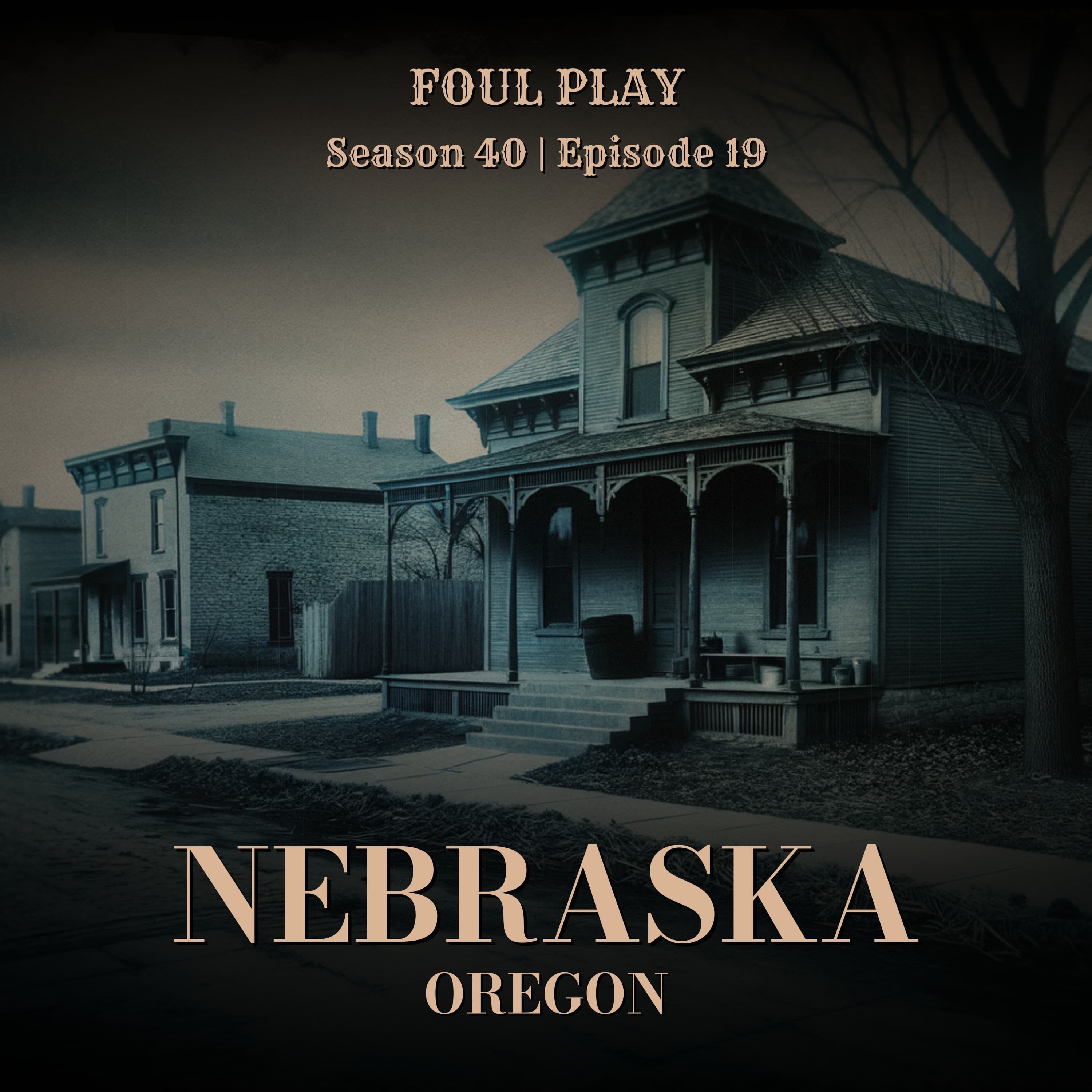
Season 40: America's 250th — fifty states, fifty crimes, two hundred and fifty years. Tonight is a double feature:
Nebraska and Oregon. Two frontier murder convictions. Two men the justice system got wrong.
May 1876. A horse breeder is found killed with an axe in a barn loft in Seward, Nebraska. His brother Warren
Clough stands over the body — the first murder victim in Seward County history. Within weeks, the community
convicts Warren on nothing but circumstance. He is sentenced to hang. Fifteen years later, the prosecutor, the
judge, and the jurors who condemned him all petition for his release, admitting they punished the wrong man.
Then, in Portland, Oregon, 1894: a waterfront murder pins on "Bunko" Kelly, the city's most notorious shanghaier
— convicted not on evidence, but on a bow tie found near the body and a reputation too convenient to ignore.
The Victims
**Nathan Clough** was a horse breeder from Postville, Allamakee County, Iowa. He had followed homestead
land westward after the Civil War, building a trade that gave him standing among farmers and ranchers across
the Nebraska plains. Nathan arrived at the Blue Valley House hotel in Seward carrying a large sum from horse
sales. He slept near his animals in the barn, as he always did. That routine cost him his life. Nathan was killed with
an axe in the barn loft. His money was gone. He was the first murder victim in Seward County history.
**George W. Sayres** was an opium smuggler working Portland's waterfront. His background, origins, family, and
age at death are undocumented. He exists in the historical record only as a victim and a criminal. In 1894, Sayres
was hacked to death and his body thrown into the Willamette River. Whatever his crimes, he was murdered —
and if historians are right that the man convicted of killing him was framed, then Sayres's actual killer was never
identified.
The Crime
In Nebraska, suspicion fell on Warren Clough immediately. He discovered Nathan's body. He knew about the
money. There was an acknowledged tension between the brothers. No physical evidence connected Warren
to the killing. None. Warren employed at least two hired men — Jacob Trent and Charles Wilcox — who had
equal access to the barn and potential knowledge of Nathan's money. The investigation never examined either
of them.
In Oregon, the prosecution argued Kelly lured Sayres from his home with a scheme to sell fake opium to members
of Portland's Chinese community. The take would have been around two hundred dollars. Instead, Sayres was
killed. The key physical evidence linking Kelly to the murder: a bow tie found at or near the scene that resembled
a style Kelly was known to wear. Beyond the bow tie, the case was circumstantial — built on Kelly's reputation
as a shanghaier, not proof of this specific crime.
The Investigation
Warren Clough was convicted of first-degree murder and sentenced to death by hanging at a trial moved thirty
miles west to York, Nebraska, because prejudice in Seward was too deep. The night before execution, Governor
Silas Garber commuted the sentence to life. Warren entered the Nebraska State Penitentiary in Lincoln and spent
nearly fifteen years inside its limestone walls. During that time, Jacob Trent told Warren's former defense attorney
that Warren was innocent — then died of heart disease in the penitentiary before he could formally confess. The
original prosecutor, the sentencing judge, and surviving jurors all petitioned Governor John M. Thayer for Warren's
release. The Omaha Daily Bee reported it plainly: the evidence was circumstantial only, but somebody had to be
punished for the crime, and on the brother of the murdered man the blame was laid. Warren was pardoned on
January 1, 1891. He was never exonerated.
Kelly was convicted of second-degree murder in March 1895 after twelve hours of deliberation and sentenced
to life at the Oregon State Penitentiary in Salem. He served thirteen years. Historian Barney Blalock, whose
2014 study The Oregon Shanghaiers was the first rigorously sourced account of Portland's crimping trade,
assessed the case as politically motivated — likely engineered to remove Kelly after he broke from Larry Sullivan's
shanghaiing syndicate. Kelly was released in 1908, wrote a memoir nobody bought, conducted a book tour in
Seattle in 1909, and disappeared from the historical record entirely.
Historical Context
These cases span America's frontier and Gilded Age justice systems. In 1876 Nebraska, there was no forensic
science, no fingerprinting, no detective force. A coroner's jury of local men served as both investigators and grand
jury. In 1890s Portland, Andrew Furuseth — president of the International Seamen's Union — testified before
Congress that the city was the greatest crimping den in America, where boarding house keepers kidnapped men
off the streets and sold them to ships for thirty to one hundred dollars per head. Both convictions were built on
community suspicion, political convenience, and the demand for punishment — not proof.
Our Sponsors:
* Check out Kensington Publishing: https://www.kensingtonbooks.com
Advertising Inquiries: https://redcircle.com/brands
Privacy & Opt-Out: https://redcircle.com/privacy
Credits
Shane Waters, Founder & Host
Wendy Cee, Co-Host
Produced by Myths & Malice
Listen to Foul Play: A Historical True Crime Podcast
Get More from Foul Play: A Historical True Crime Podcast
Unlock exclusive content and support the show.
- Ad-free listening
- Early access to episodes
- Bonus episodes
- Support independent podcasting
the M&M Dispatch
Get new Foul Play: A Historical True Crime Podcast episodes and case updates from across the network.
Enjoying Foul Play: A Historical True Crime Podcast?
Leave a rating on Apple Podcasts. It takes a few seconds and helps new listeners find the show.