Historical true crime. Seasonal investigations.Hosted by Shane Waters and Wendy Cee32 min episode
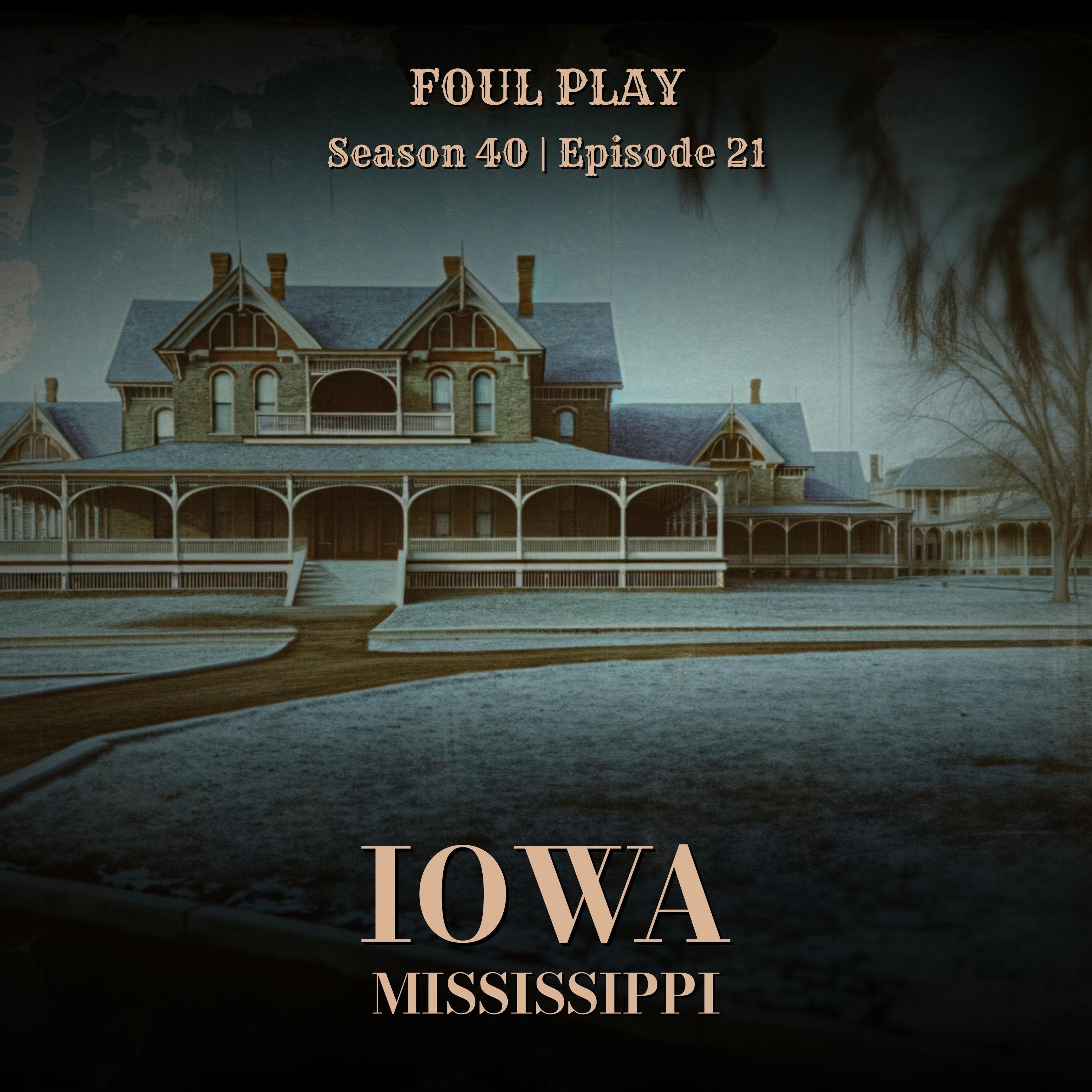
Iowa & Mississippi: Quiet Deaths, 1897
Transcript
288 segmentsShow Notes
Season 40: America's 250th — fifty states, fifty crimes, two hundred and fifty years. Tonight's double feature:
Iowa and Mississippi. September and October 1897. A farmer shot through his own dining room window with
his own gun. An elderly couple beaten, shot, and burned in their cottage on the Gulf Coast. Two homes. Two
murders. One question neither state could answer — who is safe inside their own walls?
The killer in Iowa never brought a weapon. The killer in Mississippi had been invited in. Both crimes happened in
the spaces where the victims felt most protected. This is what quiet deaths means — not the headline crime,
but the one that happens at the kitchen table, on a night when nobody is watching.
The Victims
Fred Quade was a forty-seven-year-old German immigrant farming in Greenfield Township, Calhoun County,
Iowa. Born Friedrich Wilhelm Quade in 1849 in Frotheim, Germany, he crossed the Atlantic in 1884 with his wife
Ellas and six children, entering through Baltimore and settling near Knierim. Three more sons were born in Iowa.
Nine children total. A man of routine. Of labor. Of the land.
John Stevenson Parkhurst was born in 1827. Caroline F. Boardman was born in 1832 in Plattsburg, New York.
Both had lived full lives alone before they found each other. They married on January 23, 1894, in Biloxi, Harrison
County, Mississippi — he was approximately sixty-six, she approximately sixty-one. They settled in a cottage on
the Back Bay of Biloxi, sheltered water away from the Gulf. Three years of marriage. That is what they had.
The Crimes
On the evening of September 29, 1897, Fred Quade sat at his dining room table after a long afternoon pressing
grapes. He fell asleep in his chair, his right side turned toward the window. Around eleven o'clock, someone
removed the ill-fitting screen from the dining room window, leveled Fred's own double-barreled shotgun loaded
with his own No. 6 shot, and fired at point-blank range. Fred never spoke again. He died roughly fifteen minutes
later.
Three weeks later and seven hundred miles south, on October 21, 1897, someone entered the Parkhurst home
on the Back Bay of Biloxi. John and Caroline Parkhurst were murdered with bullets and blows — gunfire and
blunt-force trauma. John was approximately seventy. Caroline was approximately sixty-five. After the killing, the
murderer set the house ablaze. The home burned, the bodies burned, and whatever evidence might have survived
was consumed.
The Investigations
The Iowa case produced evidence that belonged in a crime lab decades ahead of its time. Investigators recovered
Fred Quade's shotgun on the property. The ammunition matched his own supply. The decisive evidence was
the wadding — a torn piece of brown wrapping paper printed with a dress pattern, traced to a trunk inside an
unoccupied building on the Quade farm. The torn edges of the wadding matched the torn edges of the pattern
paper exactly. The killer had used Fred's gun, Fred's ammunition, and paper hidden inside a building on Fred's
property. Only someone intimately familiar with that farm could have assembled this weapon.
On October 8, 1897, Calhoun County Sheriff R.A. White arrested Fred's daughter Mary, her mother Ellas, and
her brother Anton as accessories to murder. Mary — twenty-one, pregnant, and unmarried — was the primary
suspect. The preliminary hearing before Justice C.R. Nicholson in Manson released Ellas and Anton. Mary was
bound over to the grand jury in Rockwell City, the county seat. On October 27, the grand jury found insufficient
evidence to indict. No one else was ever charged. The Quade family maintained what researchers describe as a
conspiracy of silence, taking all secrets about the murder to the grave.
In Mississippi, the investigation led to Harry G. Gibson, born around 1870, a native of Indiana. The Parkhursts had
befriended Gibson and given him employment. The motive was believed to be robbery. Gibson was indicted on
January 17, 1898, and convicted by jury on January 29 — twelve days from indictment to guilty verdict. The
Mississippi Supreme Court affirmed the conviction and set the execution for June 30, 1898, later delayed to
July 16. On that date, Gibson was hanged at Mississippi City, then the Harrison County seat. He became the
first person ever legally executed for a crime in Harrison County — in a state where, between 1882 and 1968,
Mississippi recorded more lynchings than any other state. That Harrison County processed Gibson through grand
jury, trial, appeal, and lawful execution was not the norm. It was the exception.
Historical Context
Iowa in 1897 was agricultural isolation made physical. No telephone service had reached Greenfield Township.
Manson, the nearest town, sat seven miles away. A crime committed in a farmhouse at eleven at night was a
crime committed in near-total privacy. Harrison County, Mississippi, was a different world — its population more
than doubled to twenty-one thousand by 1900, driven by the oyster canning industry and close to a hundred
industrial firms. The Gulf Coast attracted seasonal laborers, drifters, and transients. Mississippi City would lose
its status as county seat just four years after Gibson's execution, when the seat moved to Gulfport in 1902.
Our Sponsors:
* Check out Kensington Publishing: https://www.kensingtonbooks.com
Advertising Inquiries: https://redcircle.com/brands
Privacy & Opt-Out: https://redcircle.com/privacy
Credits
Shane Waters, Founder & Host
Wendy Cee, Co-Host
Produced by Myths & Malice
Listen to Foul Play: A Historical True Crime Podcast
Get More from Foul Play: A Historical True Crime Podcast
Unlock exclusive content and support the show.
- Ad-free listening
- Early access to episodes
- Bonus episodes
- Support independent podcasting
the M&M Dispatch
Get new Foul Play: A Historical True Crime Podcast episodes and case updates from across the network.
Enjoying Foul Play: A Historical True Crime Podcast?
Leave a rating on Apple Podcasts. It takes a few seconds and helps new listeners find the show.