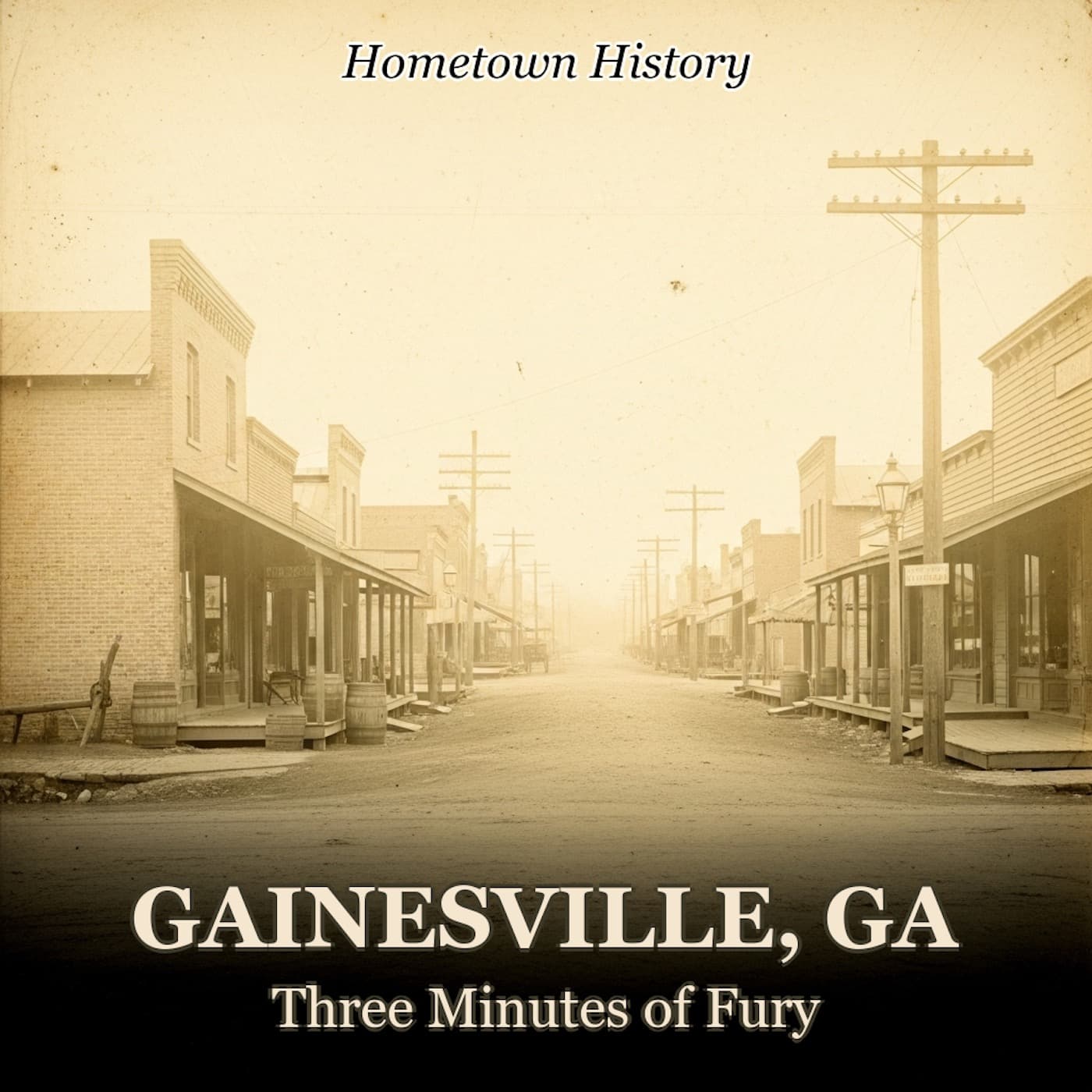
Forgotten stories from America's small towns.Hosted by Shane Waters16 min episode
The Gainesville Tornado: 203 Dead in 3 Minutes
Transcript
139 segmentsShow Notes
On April 6, 1936, two tornadoes merged over Gainesville, Georgia, and in just three minutes, killed 203 people, the deadliest tornado in a single building in American history. This is the haunting story of the Cooper Pants Factory disaster and how one catastrophic afternoon changed building codes forever.
Gainesville, nestled in the Blue Ridge foothills, was thriving during the Great Depression. Known as the "Queen City of North Georgia's Mountains, " this manufacturing hub of nine thousand residents had managed to weather the economic crisis better than most American towns. Cotton mills, poultry plants, and garment factories provided steady work for families desperate for income. At the corner of West Broad and Maple Streets stood the Cooper Pants Factory, a brick structure built in 1893 where approximately 125 workers, mostly young women and girls, stitched trousers for meager wages that nonetheless kept families fed.
But the building had a fatal flaw: one staircase. One entrance. One exit. For 125 people.
The morning of Monday, April 6th began like any other. Sewing machines hummed to life. Thread was loaded. Workers settled into their shifts with no knowledge that a meteorological catastrophe was forming in the mountains to the west. Just the day before, an F5 tornado had devastated Tupelo, Mississippi, killing over 216 people, the fourth deadliest tornado in American history. The same storm system that spawned that destruction was now pushing eastward, producing a dozen tornadoes across the Southeast in less than twenty-four hours.
Gainesville had no warning system. No sirens. No weather radar. Two separate storm cells were forming in the hills west of town, moving inexorably toward each other on a collision course with fate.
Among those who would experience the disaster firsthand was C.F. "Stubby" Fiammett, a tobacco salesman attempting to drive to town when the unthinkable happened. As the two tornadoes merged directly over the city, the Cooper Pants Factory, that building with one staircase for 125 people, became a death trap. The structure collapsed in on itself, trapping workers under tons of brick and twisted steel. Fiammett found himself pinned under the wreckage, conscious and listening as the screams of trapped factory workers echoed through the ruins around him. For nearly three hours, he lay there, trapped, as the sounds of human suffering grew fainter. Not because rescue was arriving, but because the women were dying.
This episode explores the meteorological perfect storm, the architectural failures that amplified the tragedy, and the survivors' harrowing accounts of those three minutes of hell. We'll examine how this single disaster forced America to completely rethink building safety codes, fire exits, and structural standards. The Gainesville tornado became a watershed moment in American disaster history, proof that sometimes it takes unimaginable tragedy to force systemic change.
Join us as we walk the streets of this Georgia town and uncover the human stories buried in the rubble of industrial America. This is Hometown History: where local stories changed the world.
Hometown History explores forgotten stories from small-town America. The overlooked events, hidden triumphs, and buried tragedies that shaped the country we live in. New episodes every Tuesday. Find every episode at mythsandmalice.com/hometown-history
Episode 202 | Hometown History | Hosted by Shane Waters
Advertising Inquiries: https://redcircle.com/brands
Privacy & Opt-Out: https://redcircle.com/privacy
Credits
Shane Waters, Founder & Host
Produced by Myths & Malice
Listen to Hometown History
Get More from Hometown History
Unlock exclusive content and support the show.
- Ad-free listening
- Early access to episodes
- Bonus episodes
- Support independent podcasting
the M&M Dispatch
Get new Hometown History episodes and the stories behind the towns we visit.
Enjoying Hometown History?
Leave a rating on Apple Podcasts. It takes a few seconds and helps new listeners find the show.