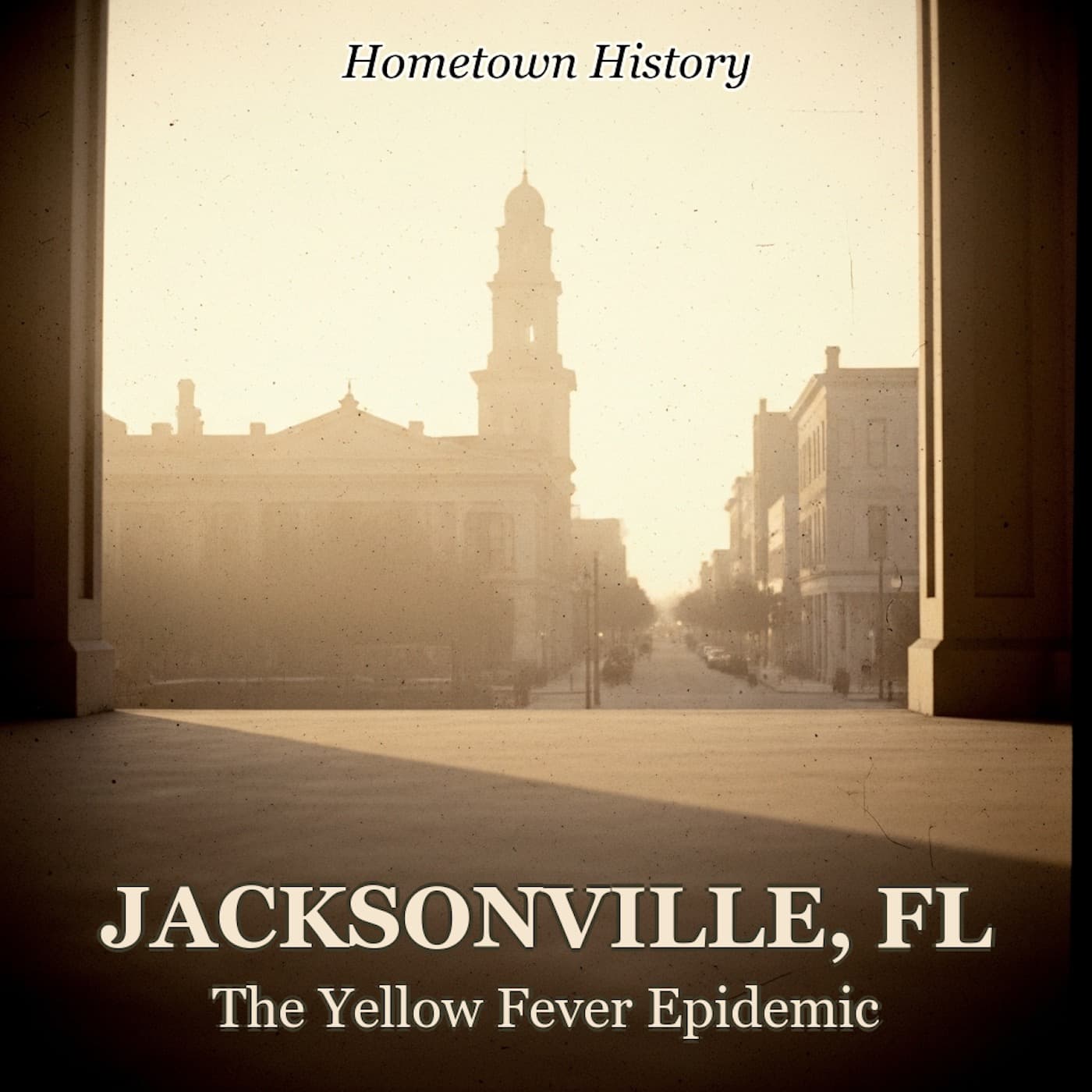
0:03 [SPEAKER_00]: July 1888. 0:04 [SPEAKER_00]: The air in Jacksonville, Florida, hangs wet and heavy, thick with jasmine and the brown water smell of the St. John's River. 0:16 [SPEAKER_00]: the heat does not break a sundown. 0:20 [SPEAKER_00]: It sits on the city like a hand pressed flat against your chest. 0:25 [SPEAKER_00]: This is America's winter playground, new hotels, northern money, railroad tracks, fanning out in every direction. 0:35 [SPEAKER_00]: On July 28th, a Tampa Saloonkeeper named R.D. 0:39 [SPEAKER_00]: McCormick stepped off a train at the depot. 0:43 [SPEAKER_00]: He is sweating more than the heat warrants. 0:47 [SPEAKER_00]: His skin has a collar. 0:48 [SPEAKER_00]: The doctors will recognize before they check his pulse. 0:53 [SPEAKER_00]: By morning, Dr. Joseph Yaked Porter, a key west physician who happens to be visiting the city, has a diagnosis that nobody injects and will wants to hear. 1:09 [SPEAKER_00]: They call it yellowjack, and editorial cartoonists across the country will soon draw it as a skeleton in a yellowsombrero, stalking the streets of a city that thought it had outgrown this kind of death. 1:25 [SPEAKER_00]: Before Yellow Jack leaves Jacksonville, refugees will be shot at on the open road. 1:32 [SPEAKER_00]: Families will abandon their sick and locked houses, and mass graves will swallow the unnamed dead, all because of a killer too small for anyone in 1888 to see. 1:47 [SPEAKER_00]: welcome back friend to hometown history. 1:51 [SPEAKER_00]: The podcast that takes a stroll down the main streets and back alleys of the past, to uncover how local stories shaped the world. 1:59 [SPEAKER_00]: I'm Shane Waters. 2:01 [SPEAKER_00]: And today we're exploring how a single sick man stepping off a train in 1888. 2:07 [SPEAKER_00]: turned Jacksonville, Florida, from America's winter paradise into a quarantine city of the dead, and accidentally built modern public health. 2:20 [SPEAKER_00]: In 1888, Jacksonville sat on a bin of the St. John's River, a city of New Hope tells winter tourists in northern railroad money. 2:38 [SPEAKER_00]: The year before, something had happened but no one quite expected. 2:43 [SPEAKER_00]: A coalition of working-class whites and African-Americans organized through the nights of labor. 2:50 [SPEAKER_00]: swept the November 1887 city election. 2:54 [SPEAKER_00]: They took 13 of 18 city council seats. 2:59 [SPEAKER_00]: Five of those council members were African-American. 3:03 [SPEAKER_00]: The city seated a black municipal judge. 3:09 [SPEAKER_00]: 23 Black Officers made up the majority of the police force, Mayor Charles Bristan Smith, a progressive white Republican, aligned with the Knights of Labor, presided over a city government that looked nothing like the rest of the post-reconstruction south. 3:29 [SPEAKER_00]: Jacksonville was growing too. 3:32 [SPEAKER_00]: The neighborhood of LaVilla and Springfield have been a next in 1887 and the city was extending roads and services into working class and black communities for the first time. 3:46 [SPEAKER_00]: In Duval County, the future looked open, but the future had a passenger. 3:54 [SPEAKER_00]: Yellow fever had never truly left the South. 3:58 [SPEAKER_00]: The disease was still active in Havana, Key West and Tampa, in 1887. 4:05 [SPEAKER_00]: Jacksonville had survived its own outbreak back in 1877, and the city believed it had moved past that kind of threat. 4:14 [SPEAKER_00]: Dr. Neil Mitchell, president of the Duval County Board of Health, was responsible for the 4:25 [SPEAKER_00]: Acting Mayor J.W. 4:26 [SPEAKER_00]: Archibald, held authority while Mayor Smith traveled. 4:32 [SPEAKER_00]: On July 28, 1888, R.D. 4:35 [SPEAKER_00]: McCormick, a Tampa Saloon Keeper, was diagnosed by Dr. Joseph Yates Porter and a local physician. 4:44 [SPEAKER_00]: First confirmed case of yellow fever. 4:48 [SPEAKER_00]: McCormick was sent to the St. Hill's quarantine station on the city's outskirts. 4:54 [SPEAKER_00]: His belongings were fumigated. 4:57 [SPEAKER_00]: The Mayflower hotel where he had stayed was burned to the ground. 5:04 [SPEAKER_00]: The board of health called it a sporadic case, isolated, nothing to worry about. 5:12 [SPEAKER_00]: Folks, they were quite wrong about that. 5:17 [SPEAKER_00]: August 8th, four more cases confirmed. 5:21 [SPEAKER_00]: The sporadic theory was dead. 5:24 [SPEAKER_00]: Two days later, August 10th, the board of health, said the word nobody wanted to hear. 5:31 [SPEAKER_00]: the fever was, according to their official statement, prevalent, intending to assume an epidemic form. 5:41 [SPEAKER_00]: That same day, two men decided the city could not wait for the government to save it. 5:47 [SPEAKER_00]: Colonel J. J. Daniel, a respected attorney and civic leader, and former Mayor Patrick McQuade, formed the Jacksonville Oxysillary Sanitary Association, known as J.A. 6:01 [SPEAKER_00]: S.A. or J.A. 6:04 [SPEAKER_00]: Their mission organized the civic response that the overwhelmed board of health could not. 6:11 [SPEAKER_00]: And then the panic started 6:16 [SPEAKER_00]: The New York Times reported it as everyone for himself, trains packed with families rolled north, only to find armed guards and locked gates at every stop, way across Georgia threatened to tear up the railroad tracks before they would let a Jacksonville train pass through it. 6:40 [SPEAKER_00]: quarantine camps went up along the rail lines with 10-day mandatory detention and luggage fumigation with sulfur fires inside boxcars. 6:52 [SPEAKER_00]: Refugees were shot at, turned back at gunpoint, locked in countercars. 7:00 [SPEAKER_00]: The state issued immunity cards to survivors of the 1877 outbreak, documents proving prior infection and immunity, an early form of vaccination certification, 132 years before the world would argue about the same idea. 7:21 [SPEAKER_00]: Dr. Joseph Yates Porter tried to reach victims in the rural areas 7:28 [SPEAKER_00]: near Stark Florida, quarantine guards threatened to shoot him. 7:33 [SPEAKER_00]: The man who had diagnosed the first case could not cross the county line to treat the dying. 7:42 [SPEAKER_00]: Back in Jacksonville, the city tried everything. 7:46 [SPEAKER_00]: Pine and tar fires burned through the night to purify the air. 7:53 [SPEAKER_00]: Following the old Mayaz Mithiri, the disease traveled on bad smells, 8:00 [SPEAKER_00]: workers, spread line, and by chloride of mercury across the streets, toxic and useless. 8:09 [SPEAKER_00]: The Wilson battery fired cannons every five minutes through the night, because a local doctor believed artillery concussion could kill germs in the atmosphere. 8:22 [SPEAKER_00]: and here's where it gets interesting, that same doctor caught the fever himself, the cannons stopped. 8:32 [SPEAKER_00]: One measure, though, worked, and nobody understood why. 8:38 [SPEAKER_00]: They drained the standing water around the city. 8:42 [SPEAKER_00]: They did it to reduce the smell. 8:45 [SPEAKER_00]: What they actually did was destroy the breeding grounds of Idisa, Ijipti, mosquitoes, the true carriers of yellow fever. 8:54 [SPEAKER_00]: They did the right thing for the wrong reason. 8:58 [SPEAKER_00]: Sources indicate the population collapsed. 9:02 [SPEAKER_00]: From roughly 17,000, the city fell to 13,757. 9:04 [SPEAKER_00]: Of those who remained, 9,812 or 71% were African-American, 9:22 [SPEAKER_00]: Eight of 18 city council members evacuated. 9:27 [SPEAKER_00]: But four of five African-American council members stayed with their constituents. 9:34 [SPEAKER_00]: Acting Mayor J.W. 9:36 [SPEAKER_00]: Archibald evacuated on September 3rd. 9:40 [SPEAKER_00]: City council vice president, D.T. 9:42 [SPEAKER_00]: Jarrow, took over four days later. 9:46 [SPEAKER_00]: The progressive government was hollowing out, 9:54 [SPEAKER_00]: The Colored Oxillary Bureau, organized by African American community leaders, coordinated relief across black neighborhoods, that the official response was slow to reach. 10:06 [SPEAKER_00]: Dr. Alexander Donez, Jacksonville's first African American physician, stayed and treated patients from both communities, earning praise from every quarter of the city. 10:20 [SPEAKER_00]: Ms. A. 10:20 [SPEAKER_00]: B. Anthony went house to house at her own expense, delivering jugs of fresh milk to the sick, one woman with a wagon, when the city's institutions had fractured. 10:35 [SPEAKER_00]: Under Dr. D. Etchamindia, Jacea raised funds from across the country and abroad. 10:43 [SPEAKER_00]: They hired 28 doctors in 837 nurses, 10:48 [SPEAKER_00]: The sand hill's hospital was expanded with a 40-foot pavilion and new buildings. 10:55 [SPEAKER_00]: By September, it was the only thing standing between the city and total collapse. 11:02 [SPEAKER_00]: The peak hit late September. 11:04 [SPEAKER_00]: In one week, 944 new cases, 70 deaths. 11:12 [SPEAKER_00]: Colonel J. J. Daniel had told Jacksonville, stand tall. 11:17 [SPEAKER_01]: He urged the city, show the world that we have confidence in our own resources. 11:23 [SPEAKER_00]: As President of J.A., he organized the civilian relief machine. 11:29 [SPEAKER_00]: The doctors, the nurses, the money, the hospital beds. 11:33 [SPEAKER_00]: He was the most visible 11:41 [SPEAKER_00]: then the fever took him, too. 11:45 [SPEAKER_00]: The cruelty of it cut deep. 11:48 [SPEAKER_00]: The man who built the defense became a casualty of the war he was fighting. 11:54 [SPEAKER_00]: The times union called the city's responders. 11:57 [SPEAKER_00]: Christian heroes, we may almost say martyrs. 12:02 [SPEAKER_00]: Colonel Daniel was the proof. 12:05 [SPEAKER_00]: Within 48 hours of his death, the citizens of quarantine half abandoned city, raised $2,000, an enormous sum for a population under siege. 12:18 [SPEAKER_00]: They did not build a statue. 12:21 [SPEAKER_00]: They chose a living monument, the Daniel Memorial orphanage, and home for the friendless. 12:36 [SPEAKER_00]: The choice told you everything about what Yellow Jack had done to Jacksonville's families. 12:43 [SPEAKER_00]: There were too many children with no one to go home to. 12:48 [SPEAKER_00]: Late September marked the worst of it, 944 new cases in a single week, 70 dead in seven days. 13:00 [SPEAKER_00]: The sand hills hospital overflowed, mass burials filled unmarked trenches in the pine woods nearby. 13:09 [SPEAKER_00]: The New York Times reported that entire families have been swept out of existence by the plague. 13:17 [SPEAKER_03]: According to Dr. Joseph Porter's memoir, numerous instances of man's inhumanity demand could be named. 13:25 [SPEAKER_03]: The fall of 1888 was one of constant dread, actual fright, and brutal instances of neglect, or a member of a family deserted home and a sick wife in children because of uncontrollable fear. 13:37 [SPEAKER_00]: Dr. Alex Sandor Darnaz kept treating patients, Miss A.B. 13:42 [SPEAKER_00]: Anthony kept delivering milk, and beneath their feet in the standing water and the rain barrels, in the drainage ditches, the oddies aged up time mosquitoes, kept breeding, invisible, unnamed, in 12 years away from being identified as the actual killer. 14:05 [SPEAKER_00]: November 25th, the temperature dropped to 32 degrees. 14:11 [SPEAKER_00]: The first hard frost. 14:14 [SPEAKER_00]: Nobody understood why, but the dying slowed, and then stopped. 14:20 [SPEAKER_00]: The relief was overwhelming. 14:24 [SPEAKER_00]: Only five more deaths after that cold snap. 14:28 [SPEAKER_00]: The frost killed the mosquitoes, though the people of Jacksonville would not learn that 14:36 [SPEAKER_00]: The December 15th, 1888, the National and State Quarantine were officially lifted. 14:44 [SPEAKER_00]: The Clyde Line Steamboats resumed service on the St. John's River. 14:50 [SPEAKER_00]: That night, the Wilson battery fired its cannons one more time. 14:55 [SPEAKER_00]: Not at germs, but in celebration, a parade filled the streets. 15:01 [SPEAKER_00]: Jacksonville had survived. 15:04 [SPEAKER_00]: The final toll, 4,656 cases, 427 dead, out of roughly 14,000 people who stayed, approximately 1 and 3 contracted the disease. 15:21 [SPEAKER_00]: But the city that came back was not the one that went under. 15:26 [SPEAKER_00]: A progressive government did not survive. 15:30 [SPEAKER_00]: In 1889, the entire city council was removed and replaced with democratic appointees. 15:37 [SPEAKER_00]: A poll tax was implemented. 15:40 [SPEAKER_00]: Effectively silencing the African-American and working-class white voters, who had one power in 1887. 15:48 [SPEAKER_00]: Black political representation in Jacksonville would not return until the 1960s. 15:56 [SPEAKER_00]: The epidemic did not destroy democracy in Duval County, but it created the conditions for those who wanted to. 16:05 [SPEAKER_00]: Records show that from the chaos, something else was built. 16:09 [SPEAKER_00]: Governor Francis P. Fleming took office on January 8th, 1889, and called a special legislation session. 16:19 [SPEAKER_00]: that year, Florida created the State Board of Health, centralizing public health policy for the first time, replacing the patchwork of county boards that had failed during the epidemic, and the man they chose to lead it was Dr. Joseph Yates Porter. 16:37 [SPEAKER_00]: the physician who diagnosed the first case, who was threatened at gunpoint near Stark for trying to reach the sick, who watched Colonel Daniel and hundreds of others die from a disease, no one could explain. 16:53 [SPEAKER_00]: He now built the system meant to prevent it from happening again. 16:59 [SPEAKER_00]: Historians note that Porter served as Fortes' first state health officer for nearly three decades, establishing disease surveillance, quarantine protocols, and mortality statistics. 17:14 [SPEAKER_00]: In 1900, Dr. Walter Reed and his commission proved in Cuba that a deez Egyptian mosquitoes 17:28 [SPEAKER_00]: The last yellow fever outbreak in the continent of the United States occurred in 1905 in New Orleans in Pensacola. 17:39 [SPEAKER_00]: Dr. Alexander Darnez survived the epidemic. 17:43 [SPEAKER_00]: He died in February 1894 at quite a young age. 17:58 [SPEAKER_00]: He had earned it. 17:59 [SPEAKER_00]: House call by house call. 18:01 [SPEAKER_00]: It was the worst months of 1888. 18:06 [SPEAKER_00]: In 1967, developers built Gateway Mall on the site of the old Sandhill's hospital. 18:14 [SPEAKER_00]: During construction, workers and neighborhood children found what the concrete was meant to cover, hundreds of bones, the remains of yellow fever victims buried in unmarked trenches, 79 years earlier. 18:30 [SPEAKER_00]: witnessed John Hall Prize, later recalled. 18:34 [SPEAKER_02]: When they tore down the peat hills, I had two bags full of them and the museum came and took them. 18:41 [SPEAKER_00]: A police officer and a man from the Jacksonville Museum confiscated the bones. 18:47 [SPEAKER_00]: The mall went up anyway. 18:50 [SPEAKER_00]: In 1979, an eight-foot marble monument was placed at H. Warren Smith's Cemetery in Jacksonville, Beach, dedicated in memory of the legendary victims of Yellow Feaver, 1888-1889. 19:07 [SPEAKER_00]: Daniel Kiddz, the organization that grew from the orphanage, Colonel Daniel's grieving city belt, still operates today. 19:16 [SPEAKER_00]: It is Ford's oldest child serving agency, helping nearly 5,000 children and families every year. 19:25 [SPEAKER_00]: A living monument, just as the founders intended, 19:30 [SPEAKER_00]: the Florida Department of Health, direct descendant of the State Board of Health, that Dr. Joseph Yates Porter built in 1889. 19:40 [SPEAKER_00]: Still operates from the framework born of Jacksonville's worst year. 19:46 [SPEAKER_00]: And those immunity cards, the Jacksonville issued in 1888, the same concept reappeared 132 years later, when COVID-19 vaccination cards sparked the same arguments about freedom and public safety. 20:03 [SPEAKER_00]: The technology changed, the fear did not. 20:08 [SPEAKER_00]: Dr. Carlos Juan Vinlay had theorized that mosquitoes carried yellow fever before 1888, but he could not prove it. 20:18 [SPEAKER_00]: Dr. Walter Reed proved it in 1900. 20:22 [SPEAKER_00]: That 12-year gap between what one man suspected and what another man confirmed represents thousands of preventable deaths. 20:33 [SPEAKER_00]: Jacksonville's 427-dead fell into that gap. 20:39 [SPEAKER_00]: the bones beneath the old mall. 20:42 [SPEAKER_00]: The monument at the beach cemetery. 20:45 [SPEAKER_00]: The children still served by Daniel Kids. 20:49 [SPEAKER_00]: Jacksonville's 1888 epidemic left marks that have not faded. 20:56 [SPEAKER_00]: That's the story of Jacksonville's 1888 Yellowfeever Epidemic. 21:01 [SPEAKER_00]: How Yellowjack invaded America's Winter Paradise, drove its people to shoot at their own neighbors, and left mass graves that would not be found for 79 years. 21:15 [SPEAKER_00]: But from that suffering came Florida's public health system, an orphanage that still serves children today, and prove that the worst in people and the best in people can come from the same crisis. 21:33 [SPEAKER_00]: If you found this story as haunting as I did, share it with someone who believes that 21:45 [SPEAKER_00]: I'm Shane Waters, every home town has a story. 21:48 [SPEAKER_00]: Tonight, it's the bones beneath a Jacksonville shopping mall, and the doctor who turned a plague into a promise. 21:58 [SPEAKER_00]: Good night, friend.
Show full transcript (175 segments)