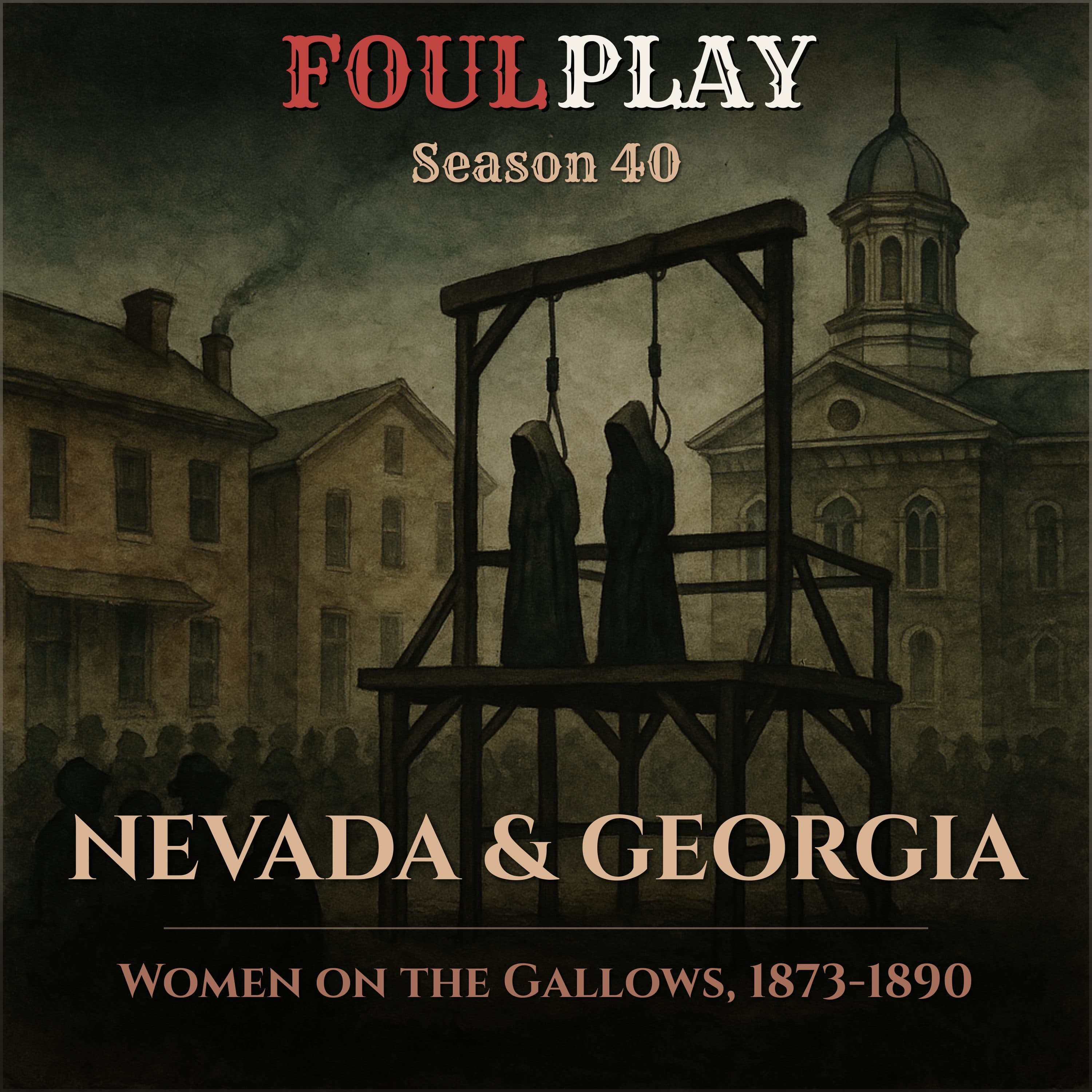
0:03 [SPEAKER_01]: New Year's Day, 1888. 0:06 [SPEAKER_01]: A man named Miles Fossett, hitches a team of forces outside a house, on Silver Street in Carlin, Nevada. 0:15 [SPEAKER_01]: He is 57 years old, Englishborn. 0:19 [SPEAKER_01]: A carpenter and a small rancher who has lived in this railroad town long enough to know everyone and be known by them. 0:28 [SPEAKER_01]: He has told his friend, J.P. Lineberger, where he is going, and why? 0:33 [SPEAKER_01]: The pot's family owes him money. 0:37 [SPEAKER_01]: He intends to collect. 0:41 [SPEAKER_01]: Fossil carries a debt note. 0:43 [SPEAKER_01]: He has done this before. 0:46 [SPEAKER_01]: Walked up to a house, knocked, settled business. 0:50 [SPEAKER_01]: Our routine visit on a cold morning. 0:58 [SPEAKER_01]: never comes back out. 1:01 [SPEAKER_01]: No one in Carlin reports him missing. 1:05 [SPEAKER_01]: For a four year, the town simply absorbs his absence. 1:10 [SPEAKER_01]: An old man who is here yesterday and isn't here today. 1:15 [SPEAKER_01]: When someone finally finds what his left of mouse faucet, it is buried beneath the cell of 1:26 [SPEAKER_01]: Except for a single pocket knife, the people of Carlin know on sight. 1:32 [SPEAKER_01]: One year, a body in the cellar, and the woman who lived above it will become the only female ever executed in Nevada. 1:44 [SPEAKER_01]: Hello friend, welcome to Fowl Play. 1:48 [SPEAKER_01]: This is season 40, America's 250th anniversary, 50 states, 50 crimes, 250 years of history. 2:00 [SPEAKER_01]: Today, Navada and Georgia, two women both sentenced to hang, one in the front to your west, one in the post civil war south, separated by 17 years and 2,000 miles, connected by a single question neither court could answer, how guilty was the woman on the gallows 2:28 [SPEAKER_01]: This is a story about the distance between what the law could prove, and what it chose to punish. 2:34 [SPEAKER_01]: It begins in a railroad town in the High Desert, where a carpenter walked into a house on New Year's Morning. 2:43 [SPEAKER_01]: It was never seen alive again. 2:45 [SPEAKER_01]: Miles' faucet was born around 1830 in England, from the same Manchester area as the family that would eventually kill him. 2:57 [SPEAKER_01]: He came west the way many English immigrants did in that era, following work, following the railroad, ending up in the towns that the Central Pacific had built from nothing in the Nevada desert. 3:12 [SPEAKER_01]: Harlan was one of those towns, a division point established in 1868, population around 800, with a business district of hotels, saloons, and a library, the railroad had stocked with 1100 bucks, a company town, in the plainest sense. 3:34 [SPEAKER_01]: Foss it worked a small ranch outside Carlin, a modest operation. 3:40 [SPEAKER_01]: The kind of single man of modest means might manage alone, dependent on water from the humble to river, and proximity to the market the trains provided. 3:54 [SPEAKER_01]: He kept to himself, no family recorded in the area. 3:59 [SPEAKER_01]: known well enough that his pocket knife was recognized on site, but private enough that his neighbors called him old man faucet and left it at that. 4:12 [SPEAKER_01]: What connected him to the pot's household was England. 4:17 [SPEAKER_01]: Shared origins in a remote front to your town meant something. 4:22 [SPEAKER_01]: Elizabeth Potts washed his clothes and baked his bread. 4:27 [SPEAKER_01]: He boarded with the family periodically. 4:31 [SPEAKER_01]: There was trust there, the kind built on familiar accents in an unfamiliar country. 4:38 [SPEAKER_01]: But underneath that trust, secret, 4:43 [SPEAKER_01]: The secret was a marriage. 4:46 [SPEAKER_01]: Elizabeth Pots had separated from her husband Josiah, in travel to Fresno, California, where she entered a bigumous marriage with Fossett. 4:56 [SPEAKER_01]: She had no money of her own. 4:59 [SPEAKER_01]: The arrangement appears to have been a financial transaction, dressed in legal ceremony. 5:06 [SPEAKER_01]: a woman, an economic desperation, binding herself to a man who could provide. 5:13 [SPEAKER_01]: What makes this significant is what happens next. 5:17 [SPEAKER_01]: Elizabeth returned to Josiah, faucet bought his ranch. 5:23 [SPEAKER_01]: The domestic arrangement continued, washing, baking, visits, obligations, but faucet now held something over her. 5:36 [SPEAKER_01]: And on New Year's Day, 1888, he came to use it. 5:42 [SPEAKER_01]: Foss it told Linebarger, he intended to collect a debt, and that he had information about Elizabeth's past. 5:49 [SPEAKER_01]: He could use as pressure. 5:52 [SPEAKER_01]: He walked to the house on Silver Street, carrying both a dead note and leverage. 5:59 [SPEAKER_01]: What happened inside that house was never witnessed by anyone outside it. 6:04 [SPEAKER_01]: Foss it, went in. 6:06 [SPEAKER_01]: For a four year, nobody saw him again, and the pots family kept living in the house, above the seller, where his body lay. 6:17 [SPEAKER_01]: Then in September 1888, they left Carlin without explanation, gone, no forwarding address, no word to anyone. 6:31 [SPEAKER_01]: January 16th, 1889, a man named George Brewer, the new tenant of the former Pott House on Silver Street, goes down into the seller. 6:43 [SPEAKER_01]: He probes the packed earth floor with an iron rod. 6:47 [SPEAKER_01]: He pulls up what he takes for a rotten turnip. 6:50 [SPEAKER_01]: It is a decapitated human head, charred, stripped of flesh, partially crushed. 6:59 [SPEAKER_01]: The excavation of that cellar revealed a mass of mutilated remains. 7:05 [SPEAKER_01]: The body had been systematically destroyed. 7:09 [SPEAKER_01]: burned, chopped, buried in pieces throughout the earth and floor, that a structure was methodical. 7:18 [SPEAKER_01]: This was not someone acting in panic. 7:21 [SPEAKER_01]: This was someone who took their time. 7:25 [SPEAKER_01]: The only identifying object, a fragment of burn trouser pocket containing an old knife. 7:32 [SPEAKER_01]: People in Carlin recognized it immediately, it belonged to Miles Fossett, 7:38 [SPEAKER_01]: Sheriff L. R. Barnard traced the Pots' family to Rock Springs' Wyoming. 7:44 [SPEAKER_01]: He, in Constable, Joe Triplet, traveled more than 500 miles to arrest the couple on February 16, 1889. 7:53 [SPEAKER_01]: On the return journey, Joe Sia cracked. 7:58 [SPEAKER_01]: His account, Foss it had killed himself after Elizabeth caught him sexually abusing their daughter, Eda. 8:06 [SPEAKER_01]: Then, approximately five years old, Josiah claimed he had dismembered and buried the body, to prevent being accused of murder. 8:16 [SPEAKER_01]: The abuse allegation was never investigated. 8:20 [SPEAKER_01]: No record of any inquiry exists in the court documents. 8:25 [SPEAKER_01]: The trial records from the Elco County proceedings reviewed by multiple historians give us the prosecution's case against that story, the systematic nature of that destruction. 8:39 [SPEAKER_01]: Burning, chopping the skull, disrupting remains throughout the cellar that kind of work takes time and deliberation. 8:52 [SPEAKER_01]: Both were charged with first-degree murder. 8:55 [SPEAKER_01]: Young Edith reportedly told authorities she had seen her mother shoot faucet, while Josiah was away. 9:03 [SPEAKER_01]: The weather this testimony was formally admitted at trial, remains unclear from surviving records. 9:10 [SPEAKER_01]: The jury deliberated four hours. 9:14 [SPEAKER_01]: Unanimous, you'll see verdict. 9:16 [SPEAKER_01]: Both sentenced to death. 9:19 [SPEAKER_01]: There are attorney appealed to the Nevada Supreme Court, a stay was ordered, the conviction was affirmed, then a petition, 267 residents of Carlin signed to their names asking the state board of Pardons to commute both sentences to life imprisonment. 9:41 [SPEAKER_01]: The board refused 9:43 [SPEAKER_01]: Sheriff Barnard himself opposed the execution. 9:48 [SPEAKER_01]: He characterized the evidence against Elizabeth as insufficient to justify hanging a woman. 9:55 [SPEAKER_01]: It didn't matter. 9:57 [SPEAKER_01]: The gallows would be built in Placerville, California, tested with sandbags, and shipped to Elco, 10:05 [SPEAKER_01]: on June 20th, 1890, both Elizabeth and Josiah Potts would stand on it together. 10:14 [SPEAKER_01]: What happened that morning would ensure that Nevada never executed a woman again. 10:21 [SPEAKER_01]: June 20th, 1890, 1030 in the morning. 10:26 [SPEAKER_01]: The yard behind the old Elco County courthouse 10:30 [SPEAKER_01]: 52 men stood as designated witnesses. 10:34 [SPEAKER_01]: Every woman who applied for a permit to attend had been denied. 10:41 [SPEAKER_01]: Sheriff Lou Barnard read the death warrants allowed. 10:44 [SPEAKER_01]: Both of Elizabeth and Josiah Pods declared their innocence. 10:50 [SPEAKER_01]: Josiah stood with his head bowed. 10:53 [SPEAKER_01]: Broken. 10:55 [SPEAKER_01]: Elizabeth stood erect. 10:58 [SPEAKER_01]: She wore a soft muslin suit, draped and black. 11:02 [SPEAKER_01]: A red rose in her bodice. 11:05 [SPEAKER_01]: She was pale. 11:07 [SPEAKER_01]: She was composed. 11:09 [SPEAKER_01]: And then she did something the observers found remarkable. 11:14 [SPEAKER_01]: She helped adjust the ropes and leather straps. 11:18 [SPEAKER_01]: On herself and on her husband. 11:24 [SPEAKER_01]: Black hoods were drawn over their heads. 11:27 [SPEAKER_01]: The double gallows, the warm built and place reveal, and tested with sandbags. 11:33 [SPEAKER_01]: Was sprung simultaneously. 11:37 [SPEAKER_01]: Josiah died slowly. 11:40 [SPEAKER_01]: Elizabeth's carotid artery, ruptured from the force, blood stained her white garments. 11:48 [SPEAKER_01]: Elizabeth Pots became and remains, the only woman ever legally executed in Nevada. 11:56 [SPEAKER_01]: The question of her guilt, whether she pulled the trigger, 11:59 [SPEAKER_01]: assisted or merely knew was never answered. 12:05 [SPEAKER_01]: The evidence was circumstantial. 12:07 [SPEAKER_01]: 267 of her neighbors said so. 12:12 [SPEAKER_01]: The sheriff who hanged her said so. 12:16 [SPEAKER_01]: The state heard them and hanged her anyway. 12:21 [SPEAKER_01]: She couldn't know, standing on that platform in her muslim suit and red rose, that no woman would ever stand there again. 12:30 [SPEAKER_01]: She couldn't know that her death would be the last of its kind. 12:36 [SPEAKER_01]: Whatever Elizabeth Pots did or didn't do, inside that house on New Year's Day, 12:41 [SPEAKER_01]: She must have been carrying the weight of it for every one of the 901 days between faucet disappearance and the moment the gallows dropped. 12:54 [SPEAKER_01]: The front here didn't know what to do with a woman who might be guilty. 12:58 [SPEAKER_01]: It hanged her anyway. 13:04 [SPEAKER_01]: Elizabeth Pots died on the only double gallows Nevada ever built. 13:10 [SPEAKER_01]: She declared her innocence, the state heard her, and hanged her anyway. 13:16 [SPEAKER_01]: two women on the gallows, one in the front tier west, one in the post civil war south, separated by 17 years and 2000 miles, both found guilty, both sentenced to die, both cases haunted by a question that neither judge, neither jury, neither governor, could settle. 13:41 [SPEAKER_01]: How much of what 13:45 [SPEAKER_01]: Elizabeth Potts had a secret, had a motive, and had a body in her cellar for a year. 13:52 [SPEAKER_01]: Whatever her role, she chose silence, she chose to stay. 13:58 [SPEAKER_01]: The woman in Georgia may not have had the luxury of choice at all. 14:05 [SPEAKER_01]: She was 18 years old, illiterate, living under the roof of a man who told her, in plain language, 14:16 [SPEAKER_01]: and that nothing she could do would stop him. 14:19 [SPEAKER_01]: December 1871, a young woman named Susan Eberhardt arrives at a one-room law cabin in Webster County, Georgia. 14:40 [SPEAKER_01]: She has been sent there by her parents to cook, wash, and care for the woman of the house. 14:48 [SPEAKER_01]: She is 18, she has had three months of schooling in her entire life. 14:53 [SPEAKER_01]: She doesn't know what is waiting for her inside. 14:58 [SPEAKER_01]: Within days of her arrival, the man who hired her begins telling her how he is going to kill his wife, Susan asks, 15:12 [SPEAKER_01]: Sarah Span was approximately 50 years old. 15:15 [SPEAKER_01]: She had lost a leg. 15:17 [SPEAKER_01]: The record doesn't say when or how. 15:20 [SPEAKER_01]: And she lived as an invalid in a one-room lock cabin in Webster County, Georgia. 15:27 [SPEAKER_01]: In the flat cotton country of the state's southwestern corner, a small world, one room, one husband, 15:37 [SPEAKER_01]: That husband was Enoch Span, a Confederate veteran whose own fellow soldiers had described him as, in their words, very ignorant and very imbesal, and, to a certain extent, crazy or of unsound mind. 15:56 [SPEAKER_01]: Sarah had been married to him for years. 15:59 [SPEAKER_01]: She depended on him for everything. 16:02 [SPEAKER_01]: She was a woman who could not walk unassisted, living in a single room with a man that people who knew him best had called unstable. 16:12 [SPEAKER_01]: The hiring of Susan Eberhardt in December 1871 was supposed to help. 16:20 [SPEAKER_01]: A young woman to do the cooking, washing and housework that Sarah couldn't manage. 16:26 [SPEAKER_01]: It was a common arrangement in rural Georgia, poor families sent their daughters out to work in households that could use the labor. 16:36 [SPEAKER_01]: Susan's parents made the arrangement. 16:39 [SPEAKER_01]: Susan went. 16:42 [SPEAKER_01]: Before the murder, Enoch's band tried to kill Sarah himself. 16:47 [SPEAKER_01]: He staged a buggy accident on the road to Sunday church. 16:52 [SPEAKER_01]: He arranged for her to be thrown into a swollen creek. 16:57 [SPEAKER_01]: Susan Eberhart waited into the water and pulled Sarah out. 17:02 [SPEAKER_01]: She saved the life of the woman she would later be convicted of helping to kill. 17:08 [SPEAKER_01]: That single act sits in the center of everything that came after. 17:13 [SPEAKER_01]: A woman who wanted Sarah dead would not have gone into a creek to save her. 17:23 [SPEAKER_00]: Susan arrived in December 1871. 17:27 [SPEAKER_00]: Within days, Enoch's band began making sexual advances and speaking openly about killing his wife so he could marry Susan. 17:34 [SPEAKER_00]: She refused him, she begged him to stop. 17:38 [SPEAKER_00]: She asked him, have you lost your mind? 17:40 [SPEAKER_00]: He didn't stop. 17:42 [SPEAKER_00]: The trial records and Dr. Fay Stapleton burn its 2018 study of the case tells us that 17:53 [SPEAKER_00]: The buggy accident was his first real attempt. 17:56 [SPEAKER_00]: Susan's intervention saved Sarah's life. 18:00 [SPEAKER_00]: Then Span told Susan he would kill Sarah, even if he were hanged five minutes afterward. 18:06 [SPEAKER_00]: The threat was not speculation. 18:08 [SPEAKER_00]: It was a statement of intent from a man his own soldiers had called unstable. 18:12 [SPEAKER_00]: Directed at an 18-year-old who had no money, no education, no family within reach, and no way out. 18:20 [SPEAKER_00]: May the 4th 1872, after 10 o'clock at night, Enoch's band strangled his wife with a plowline, breaking her neck. 18:29 [SPEAKER_00]: According to his own confession, Susan held a hand-cache over Sarah's mouth at his command. 18:35 [SPEAKER_00]: In Susan's account, she had been asleep, spent took her by the hand. 18:39 [SPEAKER_00]: He compelled her to participate. 18:41 [SPEAKER_00]: She acted under direct threat from a man who had already tried to kill twice, and had told her he would do it regardless. 18:49 [SPEAKER_00]: Sarah Span was dead. 18:51 [SPEAKER_00]: Aino Consosans fled, a Webster County Posse rode after them. 18:57 [SPEAKER_01]: The posse road out of Webster County on horseback led by Sheriff Matthews. 19:03 [SPEAKER_01]: Governor James M. Smith had posted a $500 reward for the capture of Enoch's ban and Susan Eberhardt. 19:12 [SPEAKER_01]: They had flight on foot around three in the morning, the night of the murder. 19:18 [SPEAKER_01]: It took 10 days and 125 miles. 19:22 [SPEAKER_01]: The Pasi tracked themselves and east across the state line and into coffee County, Alabama. 19:30 [SPEAKER_01]: When they were taken, Susan reportedly made statements to the arresting men during the right-backed Georgia. 19:38 [SPEAKER_01]: Those statements would become central to the 19:43 [SPEAKER_01]: The trials were held at the Superior Court of Webster County in Preston, Georgia, 26 days after the murder, 26 days from a pile line around a woman's neck to a jury box and a verdict. 20:09 [SPEAKER_01]: Susan Eberhardt was tried the next day. 20:13 [SPEAKER_01]: May 29th. 20:15 [SPEAKER_01]: She was 18 years old. 20:17 [SPEAKER_01]: She had had three months of schooling in her entire life. 20:22 [SPEAKER_01]: She could not read the indictment against her. 20:25 [SPEAKER_01]: Her jury deliberated for two hours. 20:28 [SPEAKER_01]: The length tells you something. 20:31 [SPEAKER_01]: Three minutes for Enoch meant 20:40 [SPEAKER_01]: someone in that room had doubts, guilty. 20:44 [SPEAKER_01]: Both sentenced to death on May 30, 1872. 20:50 [SPEAKER_01]: Susan was convicted as a principal in the second degree and assessed rape before the fact. 20:56 [SPEAKER_01]: The charge rested on the heiker chief. 20:59 [SPEAKER_01]: her hand over Sarah's mouth, while Enoch pulled the plowline. 21:05 [SPEAKER_01]: The prosecution argued complicity, the defense argued coercion. 21:12 [SPEAKER_01]: Here is what the defense presented. 21:14 [SPEAKER_01]: Susan Eberhardt had saved Sarah Span's life. 21:18 [SPEAKER_01]: She had waited into a swollen creek and pulled a one-legged woman from the water. 21:23 [SPEAKER_01]: A person who wanted that woman dead does not risk her own life to save her. 21:29 [SPEAKER_01]: Susan had begged Span to abandon his plan. 21:33 [SPEAKER_01]: She had begged him and her own words with tears. 21:37 [SPEAKER_01]: When they fly to after the murder, she begged him to let her go home. 21:41 [SPEAKER_01]: His answer? 21:42 [SPEAKER_01]: If you don't go, I will pick you up and tote you off. 21:47 [SPEAKER_01]: she appealed to the George's Supreme Court on January 31, 1873. 21:52 [SPEAKER_01]: The court affirmed the conviction. 21:55 [SPEAKER_01]: The question the jury could not settle in two hours, whether Susan acted from will or fear, would follow her all the way to the gallows. 22:08 [SPEAKER_01]: What happened next is the part that changes everything you think you understood about this case. 22:14 [SPEAKER_01]: The jury that convicts Susan Eberhardt signed a petition asking the governor to spare her life. 22:22 [SPEAKER_01]: The men who said she was guilty, then turned around and said she should not die. 22:29 [SPEAKER_01]: Both juries, the people who knew the evidence better than anyone else in the state of Georgia, looked at what they had done and asked the governor to undo it. 22:42 [SPEAKER_01]: newspapers across the state took up her cause. 22:46 [SPEAKER_01]: The Atlanta Daily Sun called it the most interesting case of crime that ever occurred in Georgia. 22:54 [SPEAKER_01]: Petitions circulated, communities organized. 22:59 [SPEAKER_01]: The argument was consistent. 23:01 [SPEAKER_01]: She was 18, a literate, living under the control of a man, 23:11 [SPEAKER_01]: She had saved the victim's life. 23:14 [SPEAKER_01]: Whatever she did on the night of May 4th, she did not do it freely. 23:18 [SPEAKER_01]: Governor James M. Smith received the petitions. 23:25 [SPEAKER_01]: On April 28, 1873, four days before the scheduled execution, he officially refused to commute the sentence. 23:35 [SPEAKER_01]: He said no, Enoch's ban was executed first, April 11, 1873, the Gallows and Preston drew a crowd of nearly 4,000 23:49 [SPEAKER_01]: three weeks later, on May 2, 1873, Susan Eberhart walked into the same gallows. 23:58 [SPEAKER_01]: She wore a white, hammock dress, and a calico sun bonnet. 24:04 [SPEAKER_01]: She was 19 years old. 24:05 [SPEAKER_01]: She was calm. 24:09 [SPEAKER_01]: The sheriff did not properly secure the news. 24:13 [SPEAKER_01]: Susan Eberhart's neck did not break. 24:17 [SPEAKER_01]: She choked. 24:19 [SPEAKER_01]: Her body convulsed. 24:22 [SPEAKER_01]: She drew up her arms and swung completely around, fighting to free herself. 24:29 [SPEAKER_01]: The crowd watched. 24:30 [SPEAKER_01]: A contemporary newspaper wrote that the day 24:39 [SPEAKER_01]: She was the second woman ever hanged in the state. 24:43 [SPEAKER_01]: She was 19. 24:45 [SPEAKER_01]: Governor Smith finished his term and ran for the United States Senate. 24:51 [SPEAKER_01]: He lost. 24:52 [SPEAKER_01]: He was never elected to office again. 24:54 [SPEAKER_01]: The sheriff who hanged Susan Eberhardt died years later of what was recorded as an accidental drug overdose. 25:10 [SPEAKER_01]: two women, two gallows, 17 years and 2,000 miles apart. 25:18 [SPEAKER_01]: Elizabeth Pots stood on a platform in Elcone, Nevada, in a muslim suit with a red rose. 25:26 [SPEAKER_01]: She adjusted the ropes herself. 25:29 [SPEAKER_01]: She kissed her husband, she declared her innocence. 25:33 [SPEAKER_01]: 267 of her neighbors had asked the 25:39 [SPEAKER_01]: the state hanged her, anyway. 25:43 [SPEAKER_01]: Susan Eberhardt stood on a platform in Preston, Georgia, in a white camberick dress, and a calico bonnet. 25:52 [SPEAKER_01]: She was 19. 25:54 [SPEAKER_01]: She had saved the wife of the woman she was convicted of helping to kill, bald the jury that indicted her, and the jury that convicted her. 26:10 [SPEAKER_01]: Elizabeth had a body in her cellar for a year. 26:12 [SPEAKER_01]: She had a motive. 26:15 [SPEAKER_01]: She chose silence. 26:18 [SPEAKER_01]: Whatever happened inside that house, on New Year's Day, she carried the knowledge of it for 900 in one day's. 26:25 [SPEAKER_01]: The front tier did not know what to do with a guilty woman. 26:32 [SPEAKER_01]: It hanged her. 26:34 [SPEAKER_01]: Susan pulled a one-legged woman from a swollen creek. 26:39 [SPEAKER_01]: She begged a man, she called crazy, to stop. 26:44 [SPEAKER_01]: She was 18, illiterate, alone in a house with a confederate veteran, who told her in plain language that he would kill his wife, and there was nothing she could do about it. 27:03 [SPEAKER_01]: it hanged her too. 27:06 [SPEAKER_01]: This is what season 40 keeps coming back to, 250 years of American history, and the question never changes, who gets punished, and who decides, until next time, good night friend. 27:31 [UNKNOWN]: Thank you.
Show full transcript (261 segments)