Historical true crime. Seasonal investigations.Hosted by Shane Waters and Wendy Cee35 min episode
Delaware & Montana: What the River Knows
Transcript
309 segmentsShow Notes
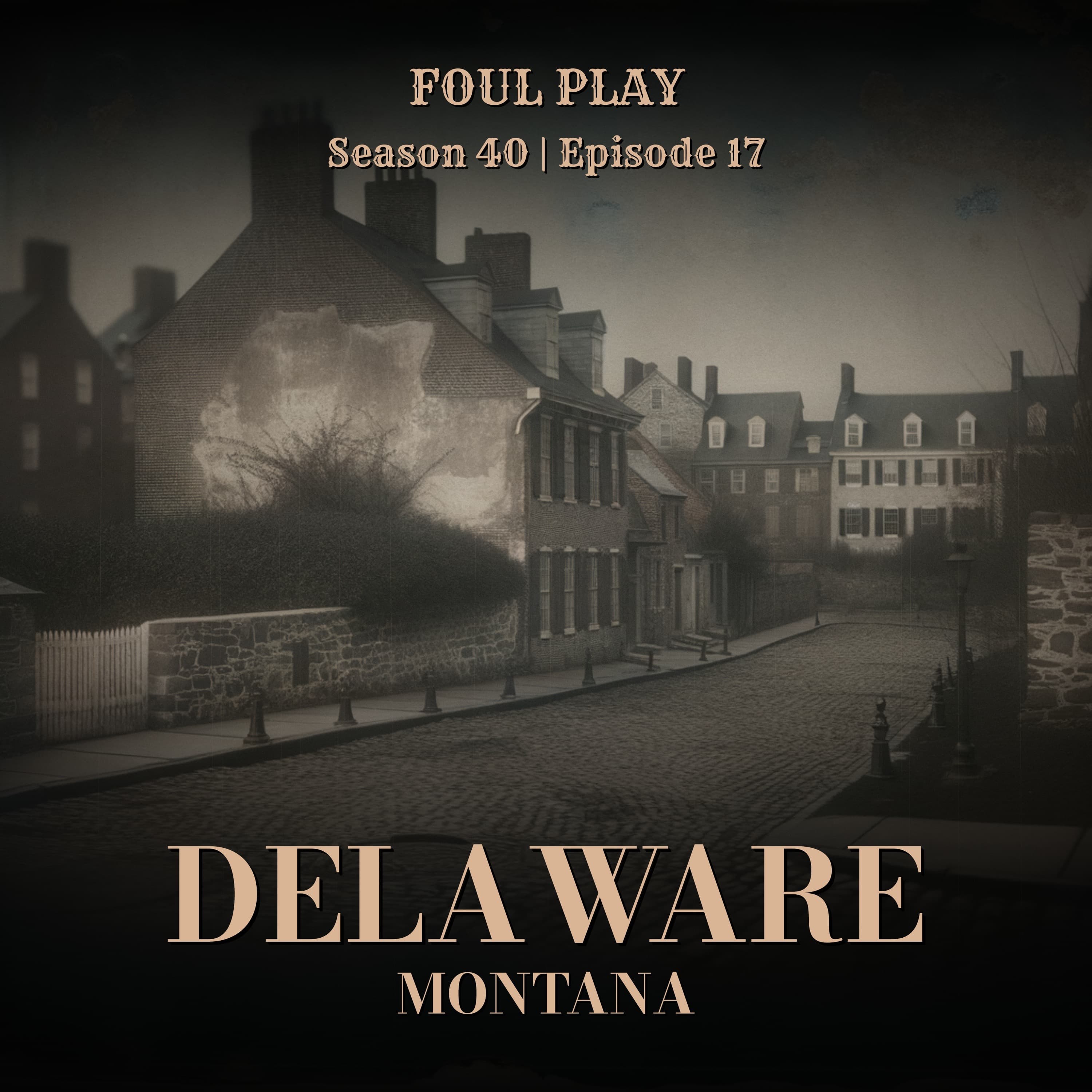
Season 40: America's 250th -- fifty true crime stories from fifty states. Delaware, 1891. A headless body in a
commercial canal, the head never recovered. Montana Territory, 1889. A drifter murders five settlers on the open
prairie, dumps them in a river, and dies before trial. His coffin, when checked, was empty.
Two waterways. Two states. Two historical murders where the water held the dead and refused to give them
back.
The Victims
**Noah Benson** was pulled from the Chesapeake and Delaware Canal in 1891 -- a headless body floating
in one of America's busiest commercial waterways. In an era before fingerprints, dental records, or circulated
photographs, the human face was the only reliable means of identification. Benson's had been taken from him.
That investigators identified him at all, through physical markings or recognition by people who knew him, speaks
to the determination of a county with no state police force and no forensic capability beyond what constables
could see with their own eyes.
**Edward and Lucina Crowell Biggs**, **Joseph and Sarah Ellen Jolliff Kurtz**, and six-year-old **Ida Schauss**
were settlers heading northeast from Helena toward the gold-mining town of Maiden in the Judith Mountains.
Ida had been formally adopted by the Kurtzes in January 1889, just months before the journey. Her biological
father, Julius Schaus of Helena, recently widowed, had placed her in the couple's care through a formal adoption
granted by Judge Howey. Sarah Kurtz, a farmer's wife of fifteen years from Iowa, knew what it took to start over.
She did not know that the man offering to guide them through the Judith Basin was planning to kill them all.
The Crimes
In Delaware, the canal that ran fourteen miles through the flatlands of northern Delaware -- connecting the
Delaware River to the Chesapeake Bay since 1829 -- gave up Benson's body but kept the one piece that mattered
most. His head was never found. A murder trial followed, drawing weeks of coverage from the *Every Evening*,
the *Morning News*, and the *Evening Journal* out of Wilmington. The prosecution had to prove who Benson
was, prove he had been murdered, and prove who did it, all without the single piece of evidence that could have
simplified everything.
In Montana Territory, **James Wilber** -- also known as Jack Gilding -- met the five settlers in Helena and offered
to guide them to Maiden. The last person outside the party to see them alive was John Beck at Castle Butte
on June 7, 1889. That evening or night, Wilber shot all five with a Winchester rifle. He loaded the bodies into
the wagon, drove through open country in daylight, and dumped them in the Judith River at Samples Crossing,
roughly twenty miles south of Lewistown.
The Investigations
Delaware's law enforcement in 1891 relied on county constables and local sheriffs. There was no state police force
(Delaware State Police would not be founded until 1923). Investigators worked without fingerprinting technology,
forensic pathology, or the victim's head. The trial reportedly concluded with a verdict, but the details remain
buried in the Delaware state archives and on microfilm at the Wilmington Public Library -- waiting for whoever
goes looking.
In Montana, a cowboy from the Moccasin roundup found a woman's body in the Judith River on June 15. Within
days, all five bodies had surfaced. The *Fergus County Argus* declared on June 20 that never in the history of
Montana had such a crime been committed. Sheriff Clary traced Wilber through a horse trade at James Wood's
ranch near Stanford. Deputy Jo. Hamilton and Sheriff Downing of Cascade County tracked him to Great Falls
and arrested him. On the night of Friday, June 21, 1889, Wilber hanged himself in his cell with his own belt. There
was no trial.
Historical Context
Delaware in 1891 maintained one of the harshest criminal justice systems in the nation. The whipping post,
known locally as "Red Hannah," was still in active use -- disproportionately against Black defendants -- and would
remain so until 1972. The canal corridor was a place between identities: Major Philip Reybold and his five sons
had once planted over 117,000 peach trees across two states, but peach yellows disease was killing the groves.
The canal itself would later be purchased by the federal government, widened, deepened, and converted from a
lock-controlled passage to a sea-level waterway. Even the crime scene was consumed.
Montana was admitted as the 41st state on November 8, 1889 -- five months after the murders. The Wilber case
was the last great crime of the territorial era. And one final mystery remained: when someone later checked
Wilber's grave at Highland Cemetery in Great Falls, the coffin was empty. The body was never found. A man who
tried to make five people disappear into a river himself disappeared from his own grave.
Our Sponsors:
* Check out Kensington Publishing: https://www.kensingtonbooks.com
Advertising Inquiries: https://redcircle.com/brands
Privacy & Opt-Out: https://redcircle.com/privacy
Credits
Shane Waters, Founder & Host
Wendy Cee, Co-Host
Produced by Myths & Malice
Listen to Foul Play: A Historical True Crime Podcast
Get More from Foul Play: A Historical True Crime Podcast
Unlock exclusive content and support the show.
- Ad-free listening
- Early access to episodes
- Bonus episodes
- Support independent podcasting
the M&M Dispatch
Get new Foul Play: A Historical True Crime Podcast episodes and case updates from across the network.
Enjoying Foul Play: A Historical True Crime Podcast?
Leave a rating on Apple Podcasts. It takes a few seconds and helps new listeners find the show.