Historical true crime. Seasonal investigations.Hosted by Shane Waters and Wendy Cee35 min episode
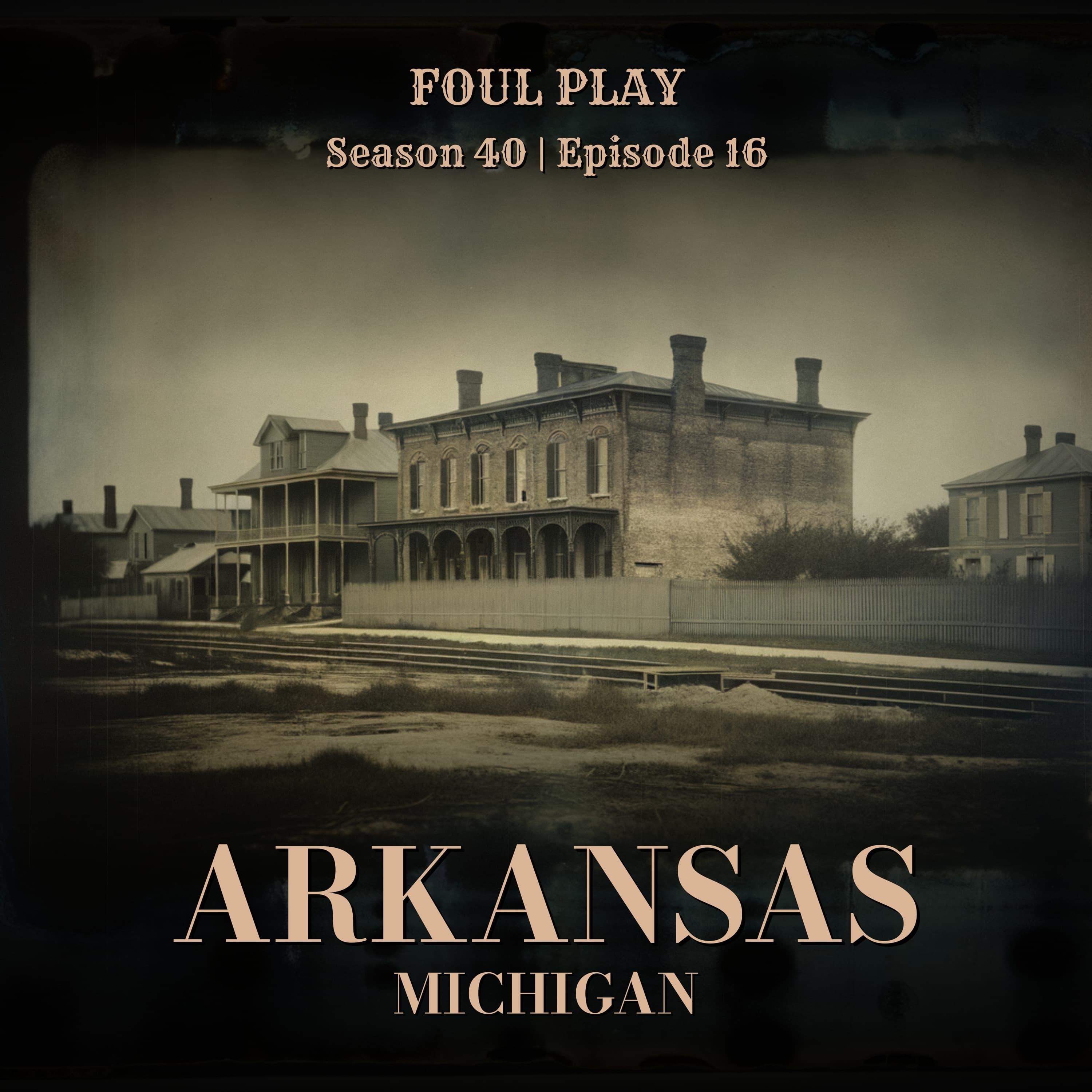
Arkansas & Michigan: Town Secrets, 1875-1912
Transcript
315 segmentsShow Notes
Season 40: America's 250th — 50 states, 50 forgotten crimes. Two communities. Two murders decades apart.
In the Arkansas Ozarks, a town rushed to convict a man on circumstantial evidence and may have hanged the
wrong person. In northern Michigan, an entire town conspired to kill its tyrannical founder — then said nothing
for sixteen years.
In 1912, eighteen-year-old Ella Barham walked to a post office in the Arkansas hills to buy cloth for a hat. She
never came home. Her dismembered remains were found scattered across a hillside that night. The community
blamed a neighbor named Odus Davidson. He was hanged within nine months. His gravestone still declares he
was innocent.
The Victims
Ella Lillian Ethel Barham was born February 16, 1894, in the Pleasant Ridge community of Boone County, Arkansas
— a scattering of homesteads along Crooked Creek in the Ozark hills. Her father, George Solomon Barham, was
one of the largest landowners in the county. Ella was eighteen, described by neighbors as popular and well-liked.
On the morning of November 21, 1912, her world measured in creek crossings and ridge trails. Her biggest concern
was a hat.
In Michigan, the victim was Albert Molitor — born 1842 in Ludwigsburg, Germany, founder of Rogers City and
the political architect of Presque Isle County. He built the sawmill, the store, the boarding house, the post office.
He paid workers in scrip redeemable only at his store. He declared himself "the King of Presque Isle County." He
was thirty-three when fifteen men decided he had to die. But the shooting that killed Molitor on August 23, 1875,
also killed Edward Sullivan — a clerk working late, a bystander, a man whose death nobody conspired to avenge.
The Crimes
In Arkansas, Ella Barham's remains were found around 9:00 p.m. by two boys and a hunter on a hillside south of
Crooked Creek. She had been decapitated, severed at the torso, both legs removed, and nearly every bone in her
skull crushed. Doctors Taylor and Lair determined she had been sexually assaulted, possibly by more than one
person. Neighbor Odus Davidson — twenty-nine, known to have expressed romantic interest Ella rejected —
was arrested within days. His seventeen-year-old brother Lair was taken in as an accomplice.
In Michigan, buckshot from at least two guns tore through the mill office where Albert Molitor and clerk Edward
Sullivan worked. Fifteen to twenty pieces of shot struck Molitor in the back and side. Sullivan took a blast through
the jaw that severed his tongue. Sullivan died the next day on a boat to Alpena. Molitor lingered approximately
three weeks before dying in Detroit.
The Investigations
The Davidson case was built entirely on circumstantial evidence: threatening statements Odus made after Ella's
rejection, red pepper-filled socks dropped from a Davidson window to confuse bloodhounds, a bloody axe at the
family woodpile, and Davidson's reluctance to join the search party. No confession. No eyewitness. No forensic
evidence that would meet modern standards. The trial before Judge George Reed lasted five days. Davidson was
not present when the jury returned its verdict of murder in the first degree after four hours of deliberation. He
was sentenced to hang.
Attorney E.G. Mitchell — a former circuit court judge — fought the conviction through the Arkansas Supreme
Court and lobbied the governor for clemency. Every effort failed. On August 11, 1913, Odus Davidson was hanged
in Harrison before a crowd numbering in the thousands. His final words were a declaration of innocence. The
rope was cut into pieces and thrown to the crowd as souvenirs.
In Rogers City, there was no investigation — not a real one. Nobody particularly wanted to find the killers. For
sixteen years the community kept its silence. In 1891, farmer William Repke turned himself in and named fourteen
other conspirators. He identified Hermann Hoeft, a rival store owner, as the mastermind and Andrew Banks as
the orchestrator. When authorities tried to seat a jury in Presque Isle County, they summoned, examined, and
dismissed 252 prospective jurors. The entire eligible pool. The trial moved to Alpena County. Five men were
convicted and sentenced to life with hard labor at Jackson State Prison. Approximately five years later, the
governor pardoned four; the fifth was pardoned roughly two and a half years after that.
Historical Context
Both cases reveal how justice operated in isolated American communities before professional law enforcement
and modern forensics. In Boone County, Arkansas, grief and certainty replaced due process. In Presque Isle
County, Michigan, a community decided collectively that a killing was deserved — and the state eventually
agreed by pardoning the convicted men. Davidson's appeal has been cited as legal precedent in numerous cases,
including the 1915 Leo Frank appeal to the U.S. Supreme Court.
Our Sponsors:
* Check out Kensington Publishing: https://www.kensingtonbooks.com
Advertising Inquiries: https://redcircle.com/brands
Privacy & Opt-Out: https://redcircle.com/privacy
Credits
Shane Waters, Founder & Host
Wendy Cee, Co-Host
Produced by Myths & Malice
Listen to Foul Play: A Historical True Crime Podcast
Get More from Foul Play: A Historical True Crime Podcast
Unlock exclusive content and support the show.
- Ad-free listening
- Early access to episodes
- Bonus episodes
- Support independent podcasting
the M&M Dispatch
Get new Foul Play: A Historical True Crime Podcast episodes and case updates from across the network.
Enjoying Foul Play: A Historical True Crime Podcast?
Leave a rating on Apple Podcasts. It takes a few seconds and helps new listeners find the show.