Historical true crime. Seasonal investigations.Hosted by Shane Waters and Wendy Cee35 min episode
Hawaii and Louisiana: The Plantation's Shadow, 1887-1889
Show Notes
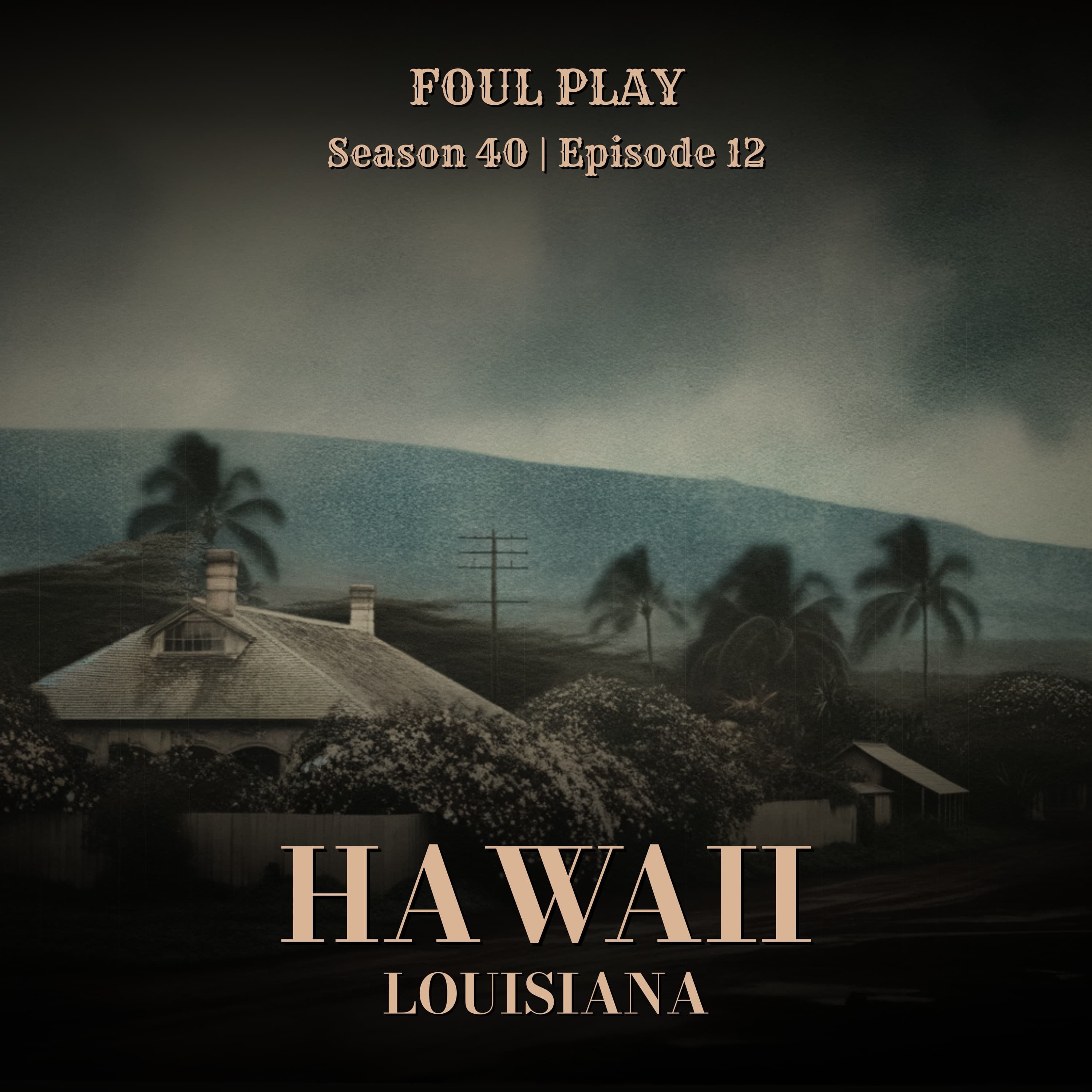
This episode is part of Season 40: America's 250th Anniversary -- 50 states, 25 double-feature episodes
exploring the cases that shaped American history from every corner of the country.
Hawaii, 1889. A Japanese shopkeeper is lynched from a telephone pole on the main street of Honoka'a for
speaking English on behalf of plantation workers. Louisiana, 1887. Ten thousand sugar cane workers strike for cash
wages instead of scrip -- and armed paramilitaries sweep through residential streets at dawn, killing between 35
and 300 people. Two plantation economies. Two communities who challenged the system. The same answer.
The Victims
Katsu Goto was twenty-seven years old when he was killed on October 29, 1889. Born in Japan in 1862, he
changed his family name from Kobayakawa to Goto to qualify for the Hawaii immigration program. He arrived in
Honolulu Harbor on February 8, 1885, aboard the SS City of Tokio -- one of 944 immigrants in the first wave of
government-contract Japanese workers under the kanyaku imin program. After three years cutting cane at nine
dollars a month on the Hamakua Coast, Goto opened a general store in Honoka'a, the second-largest town on
the Big Island. He spoke English. He used that skill to help Japanese workers file complaints against plantation
abuses. That made him a target.
In Thibodaux, Louisiana, the victims of the November 23, 1887 massacre were overwhelmingly Black -- formerly
enslaved people and their children who had struck for fair wages during the sugar harvest. Eight names survived
the historical record: Willis Wilson, Felix Pierre, Archy Jones, Frank Patterson, Grant Conrad, Marcellin Weldon,
Riley Anderson, and Mahala Washington. They represent a fraction of those killed. The full death toll has never
been established.
The Crimes
On the night of October 28, 1889, Katsu Goto rode on horseback to Robert Overend's plantation to meet with
Japanese workers who had been fined for a cane field fire they may not have set. He left the meeting around ten
o'clock. Six men were waiting on the road: Joseph R. Mills, Thomas Steele, William C. Blabon, William D. Watson,
John Richmond, and a man identified only as Lala. Goto was found the next morning hanging from a telephone
pole on Honoka'a's main street. The coroner determined he died of asphyxiation -- he was alive when the rope
went around his neck.
In Louisiana, the 1887 sugar strike began on October 29 when approximately 10,000 workers laid down their cane
knives at the start of harvest season. The Knights of Labor had demanded $1.25 per day in cash wages, elimination
of the scrip system, and biweekly payment. Governor Samuel Douglas McEnery -- himself a planter -- deployed
eleven companies of state militia to evict striking families from plantation housing. Parish District Judge Taylor
Beattie, a former Confederate and sugar planter, declared martial law over the Black population of Thibodaux,
assembled a committee of three hundred armed white men, and required Black residents to carry passes. On
the morning of November 23, 1887, armed paramilitaries moved through Black neighborhoods for more than two
hours, killing men, women, and children in their homes, yards, and streets.
The Investigation
In Hawaii, all six perpetrators in the Katsu Goto lynching were identified within weeks. Lala and Richmond
cooperated with authorities in exchange for dropped charges. The 1890 trial convicted four men of manslaughter
-- not murder. Mills and Steele received nine years; Blabon and Watson received four years each. But justice
eroded: Steele escaped to Australia, Blabon escaped to California, and Mills was pardoned in 1894 by the same
planter-aligned provisional government that had overthrown Queen Lili'uokalani the year before. Only Watson,
who played the smallest role, served his full sentence.
In Thibodaux, no one was arrested for the killings. No one was tried. No one was convicted. The bodies were
collected and dumped in unmarked graves at a site that later became the city dump. Andrew Price, a sugar planter
who participated in the attacks, was elected to the United States House of Representatives in 1889 -- two years
after the massacre.
Historical Context
Both cases occurred within plantation economies that ran on the same equation: keep labor costs low, keep
workers dependent, and make it dangerous to organize. In Hawaii, the Bayonet Constitution of 1887 had already
stripped voting rights from Asian residents. In Louisiana, the scrip system effectively trapped formerly enslaved
workers on the same land they had worked before emancipation. Black farm labor organizing in the American
South did not resume in earnest until the 1930s -- more than forty years after the Thibodaux massacre.
Today, a memorial to Katsu Goto stands near the Honoka'a Library on Mamane Street, erected in 1994 -- 105 years
after his death. A documentary, Honoka'a Hero: The Story of Katsu Goto, remains in production. In Thibodaux,
the City Council officially condemned the violence in 2017, and a state historical marker was approved for 1123
Bourbon Street. Ground-penetrating radar surveys of the former dump site have found anomalies consistent
with burials. As of 2025, excavation and formal identification have not been completed. The bodies are still in the
ground.
Our Sponsors:
* Check out Kensington Publishing: https://www.kensingtonbooks.com
Advertising Inquiries: https://redcircle.com/brands
Privacy & Opt-Out: https://redcircle.com/privacy
Credits
Shane Waters, Founder & Host
Wendy Cee, Co-Host
Produced by Myths & Malice
Listen to Foul Play: A Historical True Crime Podcast
Get More from Foul Play: A Historical True Crime Podcast
Unlock exclusive content and support the show.
- Ad-free listening
- Early access to episodes
- Bonus episodes
- Support independent podcasting
the M&M Dispatch
Get new Foul Play: A Historical True Crime Podcast episodes and case updates from across the network.
Enjoying Foul Play: A Historical True Crime Podcast?
Leave a rating on Apple Podcasts. It takes a few seconds and helps new listeners find the show.